


The Fuel Problem in Low Earth Orbit
Low Earth Orbit (LEO), an altitude range typically below 2,000 kilometres, is essential for everything from high-speed internet constellations to detailed Earth observation. Yet, operating here presents a persistent challenge. Even in what we consider
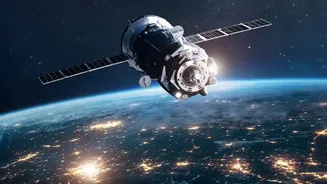
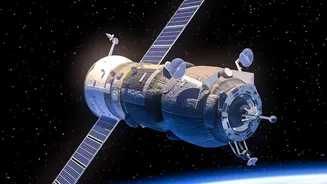
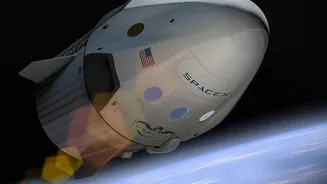
the vacuum of space, there are residual atmospheric gases. For satellites in Very Low Earth Orbit (VLEO), below about 450 kilometres, this thin atmosphere creates a constant drag, like a gentle but relentless headwind. To stay in their designated orbit and not spiral back to Earth, satellites must fire thrusters to counteract this drag. This requires carrying a finite amount of propellant, which ultimately determines the satellite's operational lifespan. Once the fuel runs out, the multi-million dollar asset's mission is over, and it becomes another piece of space junk until it eventually de-orbits and burns up. This limitation makes long-term missions in these advantageous low orbits incredibly expensive and logistically complex.
A Radical Solution: Breathing the Atmosphere
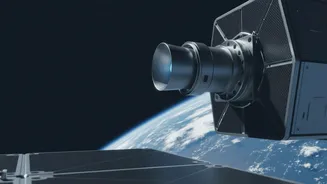
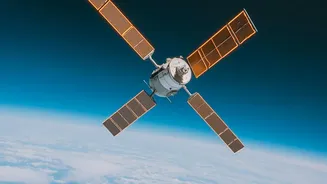
Enter Air-Breathing Electric Propulsion (ABEP). The concept sounds like science fiction but is grounded in elegant physics: what if a satellite could use the very atmospheric particles that create drag as a fuel source? Instead of carrying its own propellant, an ABEP-equipped satellite uses a specialised intake, or scoop, to collect the sparse molecules of atmospheric gas it encounters as it speeds through VLEO. These collected gases—mostly oxygen and nitrogen—are then funnelled into an electric thruster. This process effectively turns a satellite's biggest orbital challenge into its greatest asset, allowing it to generate thrust without depleting an onboard fuel tank. The concept, first proposed decades ago, is now seeing a surge in development thanks to companies like Phase Four and CU Aerospace, as well as agencies like ESA and DARPA.
How Electric Propulsion Gets Its Power
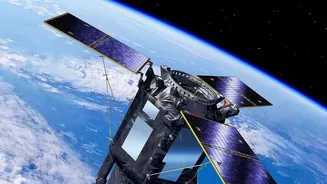
The 'electric' part of ABEP is just as crucial as the 'air-breathing' part. Once the atmospheric particles are collected, they are directed into a thruster, often a type of Hall-effect or radio-frequency thruster. Inside, the gas is ionized—meaning the atoms are given an electrical charge. An electromagnetic field then accelerates these charged particles and expels them at extremely high velocities, generating thrust. The entire system is powered by electricity, typically generated by large solar arrays and stored in batteries. This method is exceptionally efficient, producing far more thrust for a given amount of propellant mass compared to traditional chemical rockets. The key innovation is making these thrusters 'propellant agnostic,' capable of reliably using the mix of atmospheric gases they collect instead of requiring a specific, highly purified propellant like xenon or krypton.
The Sustainable Satellite Revolution
The implications of ABEP are transformative for the business of space. For satellite mega-constellations, this technology could dramatically extend operational lifetimes from a few years to potentially a decade or more, significantly improving the return on investment. This makes operating in VLEO, which offers benefits like lower latency for communications and higher resolution for imaging, a much more commercially viable proposition. Furthermore, ABEP offers a powerful solution to the growing crisis of space debris. With an estimated 6,000 tons of junk already in LEO, the risk of collisions is a serious threat to current and future missions. ABEP systems promote a cleaner space environment. Since they operate at lower altitudes where atmospheric drag is significant, a satellite can be passively de-orbited at the end of its life simply by turning off the thruster. It will then naturally and quickly burn up in the atmosphere, leaving no trace behind.
From Theory to Reality: The Path Forward
While ABEP technology is no longer purely theoretical, significant engineering hurdles remain. Designing an intake efficient enough to collect sufficient particles in the near-vacuum of VLEO is a major challenge. Another is ensuring the system's materials can withstand the corrosive effects of atomic oxygen found at these altitudes. However, progress is accelerating. The European Space Agency successfully tested a prototype on the ground, and various projects under its purview continue to advance the technology. In the United States, DARPA's Otter program is funding companies to develop and demonstrate these systems in orbit, aiming to create an 'orbiting wind tunnel' to collect crucial performance data. With this focused investment and ongoing research, air-breathing satellites are on the cusp of moving from development into the demonstration phase, promising a new era of sustainable space operations.