


A Sugar Rush in the Stars
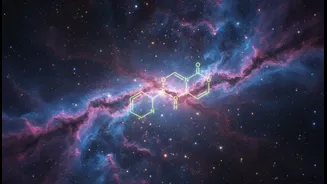
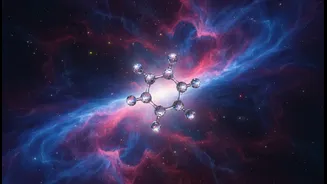
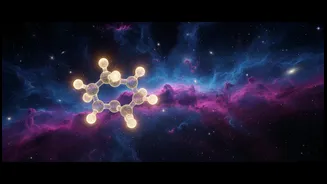
In a remarkable discovery announced very recently, astronomers have detected a true sugar molecule, erythrulose, floating in a gas cloud near the center of our Milky Way. This isn't just any chemical; erythrulose is a four-carbon sugar, part of the same
family as the molecules that form the backbone of RNA and DNA. The discovery, made by an international team using radio telescopes in Spain, is significant because it's the first time a true sugar has been found in interstellar space. Previously, scientists had found sugars in meteorites that had fallen to Earth, suggesting they might arrive from space. But finding one floating freely 27,000 light-years away in a stellar nursery called G+0.693-0.027 proves that these crucial building blocks can form long before planets even exist. This cosmic sugar, also found in raspberries, suggests that the raw materials for biology aren't unique to planets but could be a common galactic ingredient.
The Cosmic Fingerprint
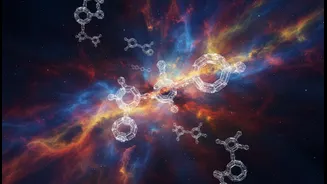
Detecting a specific molecule across thousands of light-years is a monumental task. Astronomers can't simply scoop up a sample. Instead, they rely on spectroscopy, the science of how light and matter interact. Every molecule absorbs and emits energy at specific frequencies, creating a unique barcode or "fingerprint." To find erythrulose, scientists first had to know what to look for. In a laboratory, they measured the precise spectral signature of the sugar. They then pointed powerful radio telescopes, like the IRAM 30-meter and Yebes 40-meter instruments, toward a molecular cloud known for its rich chemistry. By painstakingly sifting through the radio signals coming from the cloud, they found a faint but clear match—the unmistakable signature of erythrulose. This method of matching lab-based fingerprints to astronomical observations has been the key to identifying over 200 different molecules in space, from simple compounds to surprisingly complex ones.
More Than Just Stardust
The discovery of interstellar sugar is part of a broader, exciting trend. Astronomers are consistently finding that the chemistry of space is far more complex than once imagined. Earlier this year, scientists announced the detection of the largest sulfur-bearing molecule ever found beyond Earth, a 13-atom ring called thiepine. This was a breakthrough because sulfur is essential for proteins and enzymes in life as we know it, yet large sulfur molecules had previously been elusive in space. Other recent discoveries in star-forming regions like the Taurus Molecular Cloud have shown that molecules like methanol and acetaldehyde are widespread even in the cold, dark cores where stars have not yet ignited. This challenges the old idea that the intense heat of a newborn star is required to cook up these prebiotic ingredients. The chemical groundwork for life, it seems, is being laid in the coldest, darkest corners of the galaxy.
A Recipe for Life?
So, what does this all mean for the search for life? These discoveries do not prove that alien life exists. However, they are profoundly important because they confirm that the ingredients for life are abundant throughout the cosmos. The universe appears to be universally stocked with the chemical precursors—sugars, amino acids, complex carbon rings, and sulfur compounds—that led to life on Earth. The prevailing theory is that these molecules form on the icy surfaces of tiny dust grains in interstellar clouds. Over millions of years, these clouds collapse to form new stars and planetary systems. The very comets and asteroids that later bombard young planets, like early Earth, could have delivered this precious cargo of prebiotic molecules, kickstarting the biological processes that eventually lead to life. While we still don't know the exact recipe that turns chemistry into biology, we're learning that the universe has made sure the key ingredients are never too far away.