
A Star's Final, Violent Act
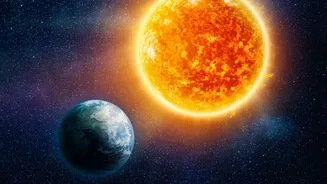
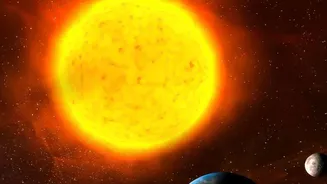
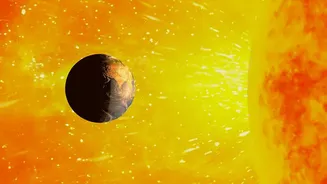
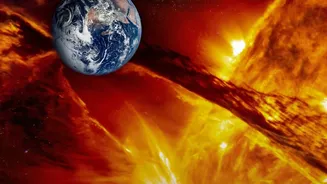
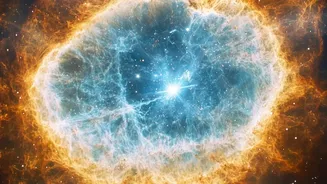
For stars like our Sun, the end of life isn't a quiet fade to black. After billions of years of fusing hydrogen into helium, the fuel in its core runs low. The star then swells dramatically into a red giant, expanding hundreds of times its original size.
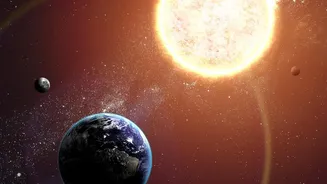
In our own solar system, this expansion will be large enough to swallow Mercury and Venus, and possibly even Earth. After this phase, the star sheds its outer layers, leaving behind a hot, dense core called a white dwarf. This stellar remnant is roughly the size of Earth but contains about half the Sun's original mass. This sudden and significant loss of mass is the trigger for cosmic chaos.
The Gravitational Shake-Up
Imagine holding a weight on a string and swinging it around you. If that weight suddenly became much lighter, the string's tension would lessen, and the object's path would change. A similar principle applies to planets. When a star loses a huge chunk of its mass to become a white dwarf, its gravitational pull on its surviving planets weakens. In response, the planets' orbits expand, migrating further away from the star. In a planetary system with multiple giant planets, like our own, this outward drift sets the stage for a dramatic and unstable future.
Simulating a Cosmic Billiards Game
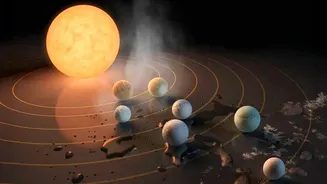
Previous models often assumed that a dying star sheds its mass smoothly and evenly. However, recent research published in The Astrophysical Journal Letters has explored a more realistic, chaotic scenario. Scientists ran hundreds of simulations where the star loses mass in uneven, random bursts, creating gravitational 'kicks' that jolt the planets. These simulations tracked planetary systems for billions of years after their star became a white dwarf. The results showed that the stately, ordered dance of the planets can break down into a violent game of cosmic billiards.
When Worlds Trade Places
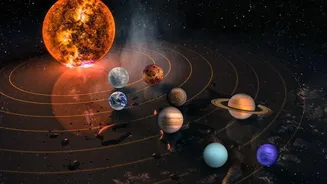
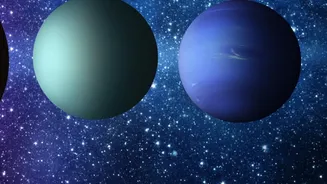
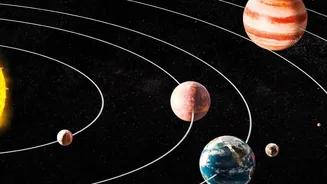
As the outer planets drift into wider orbits, their paths can begin to cross or come dangerously close to one another. What were once stable, separate lanes on a celestial highway become a chaotic intersection. The simulations showed that in many cases, the gravitational influence the planets exert on each other becomes powerful enough to completely alter the system's architecture. Some planets can be ejected entirely, flung into interstellar space to become rogue worlds. In other scenarios, planets can swap places. For instance, some simulations specifically showed Uranus and Neptune trading orbits, a once-unthinkable rearrangement that becomes possible in the gravitational turmoil following a star's death.
Could It Happen Here?
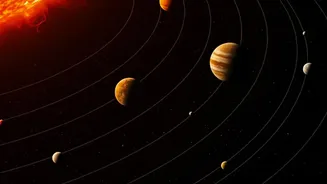
The inevitable question is whether our own solar system is destined for such a chaotic fate. According to these new models, it's a distinct possibility. While older studies predicted our solar system's outer planets would remain stable for tens or even hundreds of billions of years after the Sun becomes a white dwarf, these new simulations paint a different picture. Up to 96% of the simulated systems became unstable within just 3 billion years of their star's death. Jupiter and Saturn could be nudged into a new resonance, amplifying their gravitational tug-of-war and destabilizing the orbits of Uranus and Neptune. This doesn't mean our system is doomed tomorrow—the Sun's death is still about five billion years away. But it does mean its final act could be far more dramatic for the surviving planets than we once thought.