



Your Simple Stargazing Toolkit
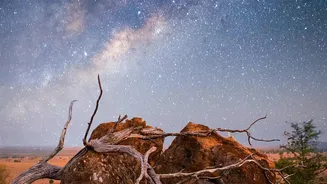
The most powerful tool for stargazing is one you already have: your eyes. To get started, you need very little else. Find a location away from the glare of city lights, even if it’s just a darker corner of your garden or a local park with an open view
of the sky. A comfortable chair or a blanket to lie on will make your viewing session much more pleasant. While a smartphone app can help you identify objects, the key is to avoid bright screens. If you need a light, use a red torch or cover a regular torch with red paper; this preserves your night vision, which white light from a phone screen will instantly ruin.
The First Rule: Be Patient
Once you've settled into your dark spot, don't expect to see everything at once. It takes about 20 to 30 minutes for your eyes to fully adapt to the darkness. During this time, you’ll start to notice more and more faint stars popping into view. Resist the urge to check your phone. The goal is to let the darkness reveal itself. This period of adjustment is not just a technical step; it’s a chance to slow down and transition from the fast pace of daily life to the serene, timeless rhythm of the night sky. Think of it as the opening act for the main event.
October’s Planetary Parade
This October offers a fantastic opportunity to spot several planets without a telescope. Saturn is the star of the early evening show. On October 4, it reaches opposition, meaning it is directly opposite the Sun from our perspective, making it visible all night long and at its brightest for the year. Look for a bright, steady, yellowish point of light in the southern sky. Unlike stars, planets don't tend to twinkle. For early risers, the pre-dawn hours offer a different treat. Look to the east to find incredibly bright Jupiter, with the dimmer, reddish Mars appearing above it.
Catch a Falling Star: The Orionids
October hosts the Orionid meteor shower, which is active for several weeks and is expected to peak on the night of October 21-22. These meteors are actually tiny dust particles left behind by the famous Halley’s Comet. This year, a bright waxing gibbous moon will light up the sky for much of the night. However, the Moon sets a few hours before dawn, creating a perfect dark window for meteor watching. Find a comfortable spot, lie back, and look up. The meteors can appear anywhere in the sky, often leaving fast, bright streaks. Under dark skies, you might see 15 to 20 meteors per hour during the peak.
Connect the Dots: Autumn Constellations
Finding constellations can feel daunting, but you only need to start with one key pattern this month: the Great Square of Pegasus. Look for a large, empty-looking square of four medium-bright stars rising in the east in the evening. It's a major signpost for the autumn sky. Another easy-to-spot shape is Cassiopeia, which looks like a distinct 'W' or 'M' in the northern sky. Once you find the Great Square, you can even try to spot another galaxy. Under truly dark, moonless skies, the Andromeda Galaxy is visible to the naked eye as a faint, elongated smudge of light. The new moon on October 10 provides the darkest skies and the best opportunity to try and spot it.