


A World Shrouded in Mystery
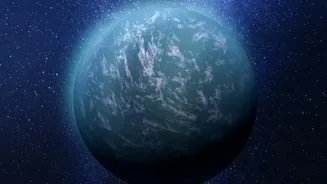
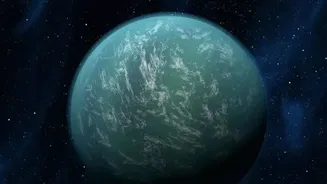
The planet at the centre of this discovery is GJ 1214 b, located about 40 light-years away. Classified as a 'super-Earth' or 'mini-Neptune', it is larger than Earth but smaller than our solar system's ice giants. For years, this world has been an enigma
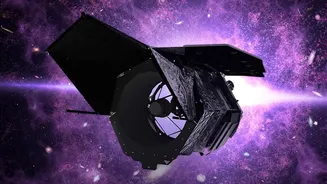
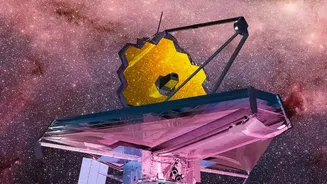
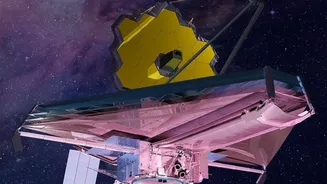
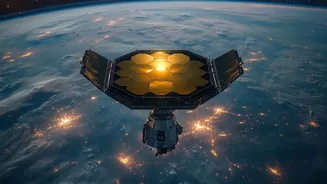
to astronomers. Previous attempts to study its atmosphere with telescopes like Hubble were foiled by a thick, impenetrable layer of haze or clouds that kept its secrets hidden. It was a cosmic puzzle box just waiting for the right key. That key, it turns out, was the advanced infrared capability of the James Webb Space Telescope (JWST), which can see through the obscuring haze that stumped its predecessors.
How Webb Peeks into Alien Atmospheres
Detecting what an exoplanet's atmosphere is made of from light-years away is a remarkable feat of science. One primary method is called transmission spectroscopy. When a planet passes in front of its star from our point of view, a tiny fraction of the starlight filters through the planet's atmosphere. Different molecules in that atmosphere absorb specific colours, or wavelengths, of light. By analysing the starlight that reaches the telescope, scientists can identify the missing wavelengths and deduce which molecules are present. For GJ 1214 b, however, scientists used an even more advanced technique. They tracked the planet through nearly its entire orbit, creating a heat map by measuring the infrared light the planet itself emits. This revealed the composition of both its day and night sides.
Steam, Not Oceans
The JWST observations revealed evidence of water vapour in the atmosphere of GJ 1214 b. However, it is crucial to manage expectations. This does not mean a world with flowing rivers and vast oceans. GJ 1214 b orbits its star at a very close distance, completing a full year in just 38 hours. Its surface is scorching hot, with daytime temperatures soaring to around 280 degrees Celsius. Under these conditions, any water would exist as a super-heated steam, making the planet completely inhospitable for life as we know it. The atmosphere is thought to be a steamy, heavy blanket, a far cry from the gentle blue skies of Earth. Scientists believe the planet may have formed farther from its star, where water was abundant as ice, and then migrated inwards over time.
A Landmark Discovery for Rocky Worlds
Despite the planet being inhospitable, the detection of a substantial atmosphere containing heavy molecules like water around a world smaller than Neptune is a monumental achievement. Planets like GJ 1214 b are the most common type in our galaxy, yet our own solar system curiously lacks one, making them a top priority for study. For years, scientists have debated what these worlds are made of—whether they are large rocky planets or small gassy ones. These findings provide the strongest evidence yet that such planets can retain thick, water-rich atmospheres. It demonstrates that the JWST, a multi-billion dollar investment in technology, is delivering on its primary promise: to characterise the atmospheres of planets beyond our solar system, paving the way for the eventual search for truly Earth-like worlds.