





The dream of clean indoor air often leads to a simple question: can a lush collection of houseplants do the job, or is a modern air purifier necessary? Let's look at the science behind both to see what effective air cleaning really means.
The Green Promise: A Famous NASA Study
The belief that
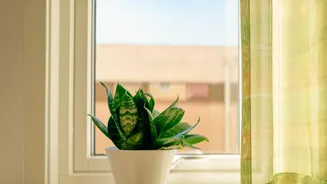
houseplants are natural air purifiers stems largely from a landmark 1989 NASA study. Researchers, looking for ways to clean the air in sealed space stations, found that certain common houseplants could remove volatile organic compounds (VOCs) like benzene and formaldehyde from small, sealed chambers. This was exciting news, and the idea quickly took root in public consciousness. Popular plants like the Snake Plant, Spider Plant, and Peace Lily became known not just for their beauty, but for their supposed air-cleaning prowess. The science in that controlled setting was sound, but its application to a typical home or office is where the story gets more complicated.
The Reality of Plant-Based Purification
The problem with relying solely on plants is a matter of scale. Your living room is not a sealed NASA chamber; it has drafts, open doors, and a constant exchange of air with the outdoors. This natural ventilation already does a lot to dilute indoor pollutants. When scientists modelled the effects of plants in a real-world setting, the results were sobering. Research showed you would need a huge number of plants to make a meaningful difference. Estimates vary, but some studies suggest it would take anywhere from 10 to 1,000 plants per square metre of floor space to match the cleaning effect of a building's ventilation system or a single air purifier. For an average-sized home, this could mean accommodating over 600 plants, an impractical jungle for most people.
Enter the Machine: How Air Purifiers Work
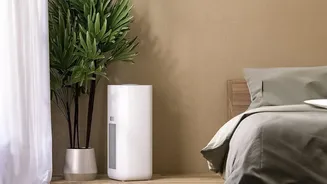
Unlike plants, which passively absorb pollutants, air purifiers are active, mechanical systems designed for one purpose: to clean the air rapidly. Most high-quality purifiers use a combination of filters. The most important of these is the HEPA (High-Efficiency Particulate Air) filter. A true HEPA filter is certified to capture 99.97% of airborne particles down to 0.3 microns in size. This includes common irritants that plants cannot address, such as dust, pollen, pet dander, mould spores, and smoke particles. Many units also include an activated carbon filter, which is effective at trapping odours and the very VOCs that the NASA plant study focused on. By actively pulling in large volumes of air and forcing it through these dense filters, a purifier can clean the air in a room multiple times per hour.
Understanding Clean Air Delivery Rate (CADR)
To compare the effectiveness of air purifiers, the industry uses a standard called the Clean Air Delivery Rate (CADR). Developed by the Association of Home Appliance Manufacturers (AHAM), CADR measures the volume of filtered air a purifier can deliver, usually in cubic feet per minute (CFM). A purifier will have three separate CADR numbers for smoke, dust, and pollen, which represent small, medium, and large particles. The higher the CADR, the faster the machine cleans the air. This metric is crucial because it combines two key factors: the purifier's fan speed (airflow) and its filter efficiency. A powerful fan with a poor filter won't have a high CADR, and neither will a great filter with a weak fan. It gives a real-world measure of performance that allows you to match a purifier to your room size. For perspective, a good air purifier can have a CADR of over 100, while the effective CADR of a houseplant is less than 1.
The Verdict: Plants for Vibe, Purifiers for Purity
When it comes to measurably improving indoor air quality, there is no contest: an air purifier is thousands of times more effective than a houseplant. If you or your family members suffer from allergies, asthma, or sensitivity to pollutants, a HEPA purifier is the only reliable solution to remove airborne triggers. However, this doesn't mean plants are useless. The psychological benefits of indoor greenery are well documented. Studies show that being around plants can reduce stress, improve mood, and boost focus. They add beauty and a sense of life to a space that a machine cannot. Think of it this way: you wouldn't hire a painter to fix your plumbing. Plants and purifiers simply have different jobs.
The Best of Both Worlds
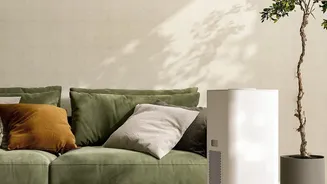
The ideal approach for a healthy home environment is not to choose between houseplants and air purifiers, but to use both. Enjoy your snake plants and peace lilies for the aesthetic calm and connection to nature they provide. They can help regulate humidity and offer psychological comfort. But for the heavy lifting of removing particulate matter, allergens, and other harmful pollutants, invest in a quality air purifier with a CADR rating appropriate for your space. This combination gives you the best of technology and nature: air that is measurably clean and a space that feels vibrant and alive.