
A New Window to Distant Worlds
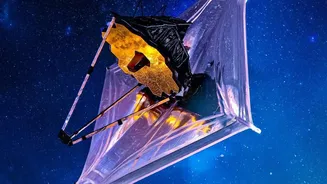
Since its launch, the James Webb Space Telescope has revolutionized astronomy, but its work on exoplanets—planets orbiting other stars—is particularly groundbreaking. For the first time, scientists have a tool powerful enough to study the thin blankets
of gas surrounding rocky, Earth-sized worlds. These planets have been notoriously difficult to study. While we have found thousands, determining if they have atmospheres, let alone what they are made of, has been a major challenge. JWST is designed to meet this challenge by using its powerful infrared instruments to capture light that has filtered through these alien skies. This capability is pushing the frontiers of exoplanet characterization from gas giants to smaller, rocky planets, enabling a completely new type of science.
The Power of Infrared Spectroscopy
So, how does it work? When an exoplanet passes in front of its star from our point of view—an event called a transit—a tiny fraction of the starlight passes through the planet’s atmosphere. Different gas molecules in that atmosphere absorb specific wavelengths, or colours, of this infrared light. By analyzing the starlight that reaches the telescope, astronomers can see which colours are missing and create a spectrum. This spectrum acts as a chemical fingerprint, revealing the composition of the planet’s atmosphere. JWST’s near-infrared and mid-infrared instruments, NIRCam and MIRI, are exceptionally sensitive, capable of detecting the subtle signatures left by gases like carbon dioxide, water vapour, and methane.
Case Study: The Lava World of 55 Cancri e
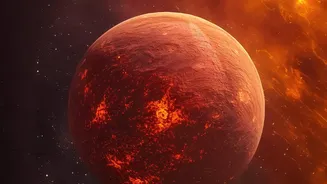
One of the most enigmatic rocky planets studied by JWST is 55 Cancri e, a super-Earth located about 41 light-years away. This planet orbits its star so closely that its surface is believed to be a molten ocean of lava. Conventional wisdom suggested that any original atmosphere would have been blasted away by the intense heat and radiation. However, JWST’s observations have provided the best evidence to date for a substantial atmosphere on a rocky planet outside our solar system. Instead of being bare rock, data indicates the planet has a dynamic atmosphere, likely rich in carbon monoxide or carbon dioxide. This atmosphere is thought to be a secondary one, constantly replenished by gases bubbling out from the planet's interior magma ocean. This discovery challenges theories about which planets can retain atmospheres, suggesting even the most extreme worlds can have complex skies.
The Search in the TRAPPIST-1 System
The TRAPPIST-1 system, with its seven Earth-sized rocky planets, is a prime target in the search for habitable worlds. JWST has been systematically studying these planets, and the results paint a complex picture. For TRAPPIST-1 b, the innermost planet, observations have confirmed it does not have a thick, hydrogen-rich atmosphere, but contamination from its very active star makes it difficult to determine if a thinner, secondary atmosphere exists. Similarly, studies of TRAPPIST-1 d, which lies on the edge of the habitable zone, have not detected an Earth-like atmosphere, though it could have a very thin one like Mars or be shrouded in high-altitude clouds. Even TRAPPIST-1 e, a compelling candidate for habitability, has been a challenge. While a thick, carbon dioxide-rich atmosphere like Venus seems unlikely, scientists cannot yet rule out a bare rock or a nitrogen-rich atmosphere. These findings highlight the immense difficulty of spotting atmospheres on smaller, cooler planets orbiting active red dwarf stars.
Just the Beginning of a New Chapter
The early discoveries from the James Webb Space Telescope are both thrilling and humbling. We are seeing that rocky worlds are incredibly diverse, from lava planets with outgassing atmospheres to others that may be bare rock. These initial observations are forcing scientists to rethink long-held theories about how planets form and retain their atmospheres. Each new spectrum captured by JWST provides another piece of the puzzle, refining our understanding and guiding future observations. While the detection of a true Earth-twin remains elusive, the telescope is providing the critical groundwork and proving it has the power to one day make such a discovery. The search for life elsewhere in the cosmos is a marathon, not a sprint, and with JWST, we have just started a very exciting new lap.