




A Day Longer Than a Year
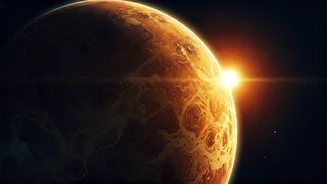
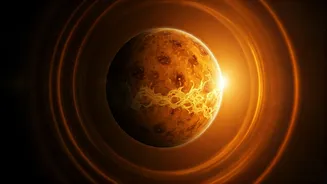
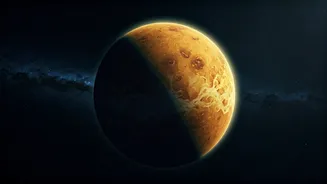
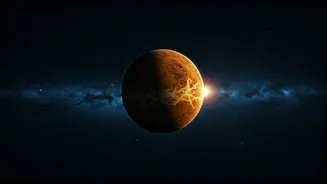
Let’s get the mind-bending numbers out of the way first. Venus completes one full orbit around the Sun in about 225 Earth days. This is its year. However, it takes a staggering 243 Earth days for Venus to complete just one rotation on its axis. This is its day.
So, if you were standing on Venus, you would celebrate your first ‘new year’ before you had even finished your first ‘day’. This makes Venus the only planet in our solar system with a day longer than its year. It’s a planetary quirk that has fascinated astronomers for decades, turning our basic understanding of 'day' and 'year' completely on its head.
The Slowest, Backward Spin
Not only is Venus’s rotation painfully slow, but it’s also backward. Most planets in our solar system, including Earth, spin on their axis in a counter-clockwise direction (prograde motion). If you look down from above the Sun's north pole, you'd see them spinning like a top. Venus, however, spins clockwise. This is known as retrograde rotation. The combination of this slow, backward spin creates another strange effect: its solar day (the time from one sunrise to the next) is different from its rotational period. On Venus, you would only see a sunrise every 117 Earth days, meaning there are roughly two sunrises for every Venusian year.
Why Is Venus So Strange?
Scientists don't have a single, definitive answer for Venus's bizarre rotation, but there are a few leading theories. One popular hypothesis suggests that Venus may have been struck by a massive asteroid or another planet-sized object early in its history. Such a cataclysmic impact could have been powerful enough to not only slow its original rotation to a crawl but completely reverse its direction. Another theory points to Venus's incredibly thick and heavy atmosphere—about 90 times denser than Earth's. Scientists speculate that over billions of years, powerful solar tides acting on this dense atmosphere, combined with friction at the core-mantle boundary, could have gradually slowed and reversed the planet’s spin. The truth might be a combination of these factors.
Earth's Hellish Twin
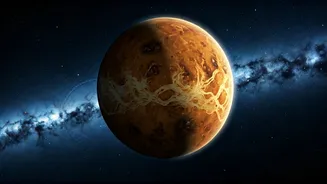
This strange rotation is just one feature that makes Venus a truly alien world. Often called Earth's 'twin' due to its similar size and composition, Venus is anything but hospitable. Its thick atmosphere is composed mainly of carbon dioxide, trapping heat in a runaway greenhouse effect. This results in surface temperatures hot enough to melt lead—averaging around 465 degrees Celsius. The atmospheric pressure on the surface is equivalent to being a kilometre deep in Earth's ocean, a force that would crush any human or spacecraft not specifically designed to withstand it. The slow day contributes to this extreme climate, as the 'day' side bakes under the sun for months at a time, while the 'night' side also remains incredibly hot due to the thick atmospheric blanket.