



A Planet of Epic Seasons
Saturn’s vast orbit and axial tilt give it seasons, much like Earth. But a single year on Saturn takes about 29 Earth years to complete. This means each season—spring, summer, autumn, and winter—drags on for more than seven years, bringing profound changes
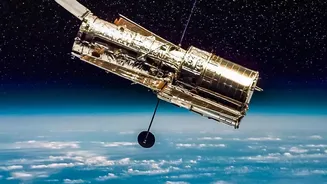
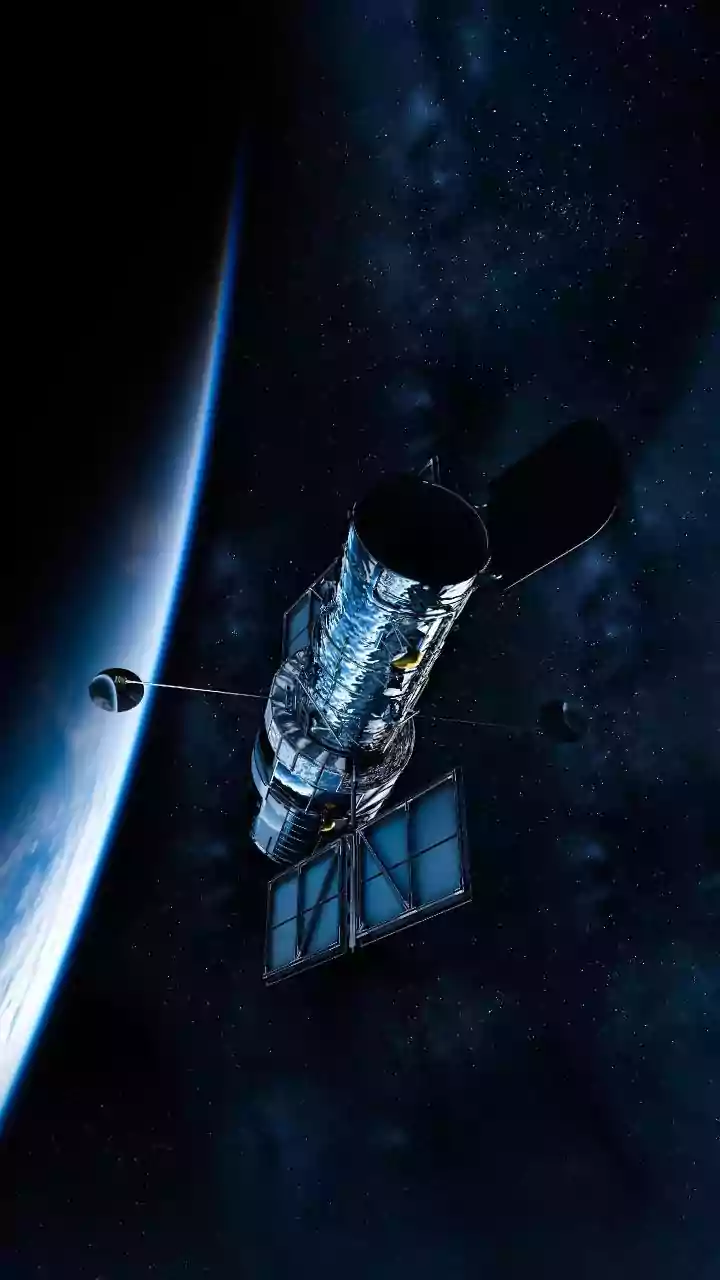
to the gas giant's atmosphere. For a long time, observing these slow-motion changes was a challenge. But the longevity of the Hubble Space Telescope has given astronomers a unique opportunity. Through its consistent, long-term observations, scientists can finally build a continuous record of Saturn's atmospheric evolution, watching as one hemisphere slowly warms in the sunlight while the other cools in the long winter darkness.
Hubble's Long-Term Vigil
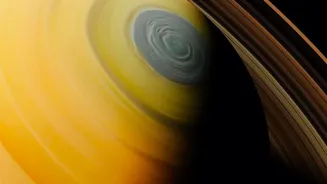
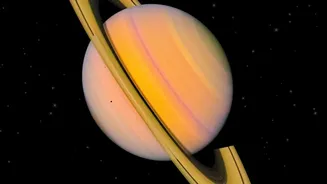
To track changes that take decades to play out, you need a patient observer. The Hubble Space Telescope, through dedicated programs like the Outer Planet Atmospheres Legacy (OPAL), has been annually monitoring Saturn for years. This has created an invaluable timeline of data, showing how the planet's colourful bands of clouds shift, storms erupt and fade, and temperatures change from year to year. These observations, taken in visible light, capture the subtle colour variations in the upper cloud layers, such as a reddish haze that can appear over a hemisphere due to increased summer sunlight.
The Power of Seeing in Infrared
While visible light shows the surface of the clouds, infrared observations allow scientists to peel back the layers of Saturn's atmosphere. Infrared light is key to sensing heat. By observing in this spectrum, Hubble can track temperature changes at different altitudes. This is crucial for understanding seasons, which are driven by variations in solar energy. These infrared views can cut through the planet's upper haze to reveal the structure of clouds and chemicals at various depths. This ability to 'slice' through the atmosphere helps researchers connect changes in sunlight to specific effects, like how winds change speed or how atmospheric hazes are formed and dissipated.
What the New Observations Reveal
Recent observations combine Hubble's long-term data with the powerful infrared capabilities of the James Webb Space Telescope, providing the most comprehensive view of Saturn to date. These joint observations track the planet as it moves towards its 2025 equinox, a time when both hemispheres receive equal sunlight. Data from recent years has shown significant changes. For instance, between 2018 and 2020, Saturn's equator brightened by 5 to 10 percent, and wind speeds that were measured at 1,600 kilometres per hour decreased back to earlier recorded speeds of around 1,300 kilometres per hour. One theory is that these changes in wind speed indicate that the clouds observed were at different altitudes from year to year. The infrared data also reveals temperature asymmetries between the summer and winter poles, with the summer pole being significantly warmer.
Why Tracking Saturn's Weather Matters
Studying Saturn's seasons is about more than just a weather report for a distant world. Saturn acts as a giant natural laboratory for planetary science. Understanding the balance between its internal heat and the solar energy it receives helps explain the forces that drive its massive storms and powerful jet streams. This knowledge is not just limited to Saturn. It provides critical insights into the atmospheric physics of all gas giants, including the thousands of exoplanets discovered orbiting other stars. By seeing how Saturn’s atmosphere responds to seasonal change, scientists can build better models to understand the climates of these distant worlds and, ultimately, the fundamental principles that govern all planetary atmospheres, including our own.