




A Cosmic Collision Next Door
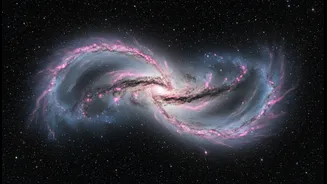
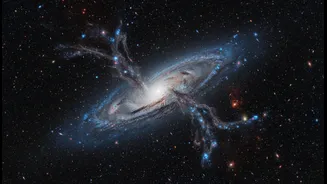
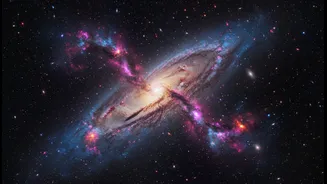
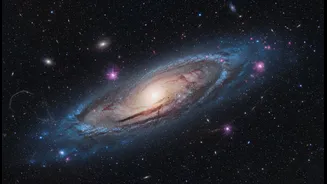
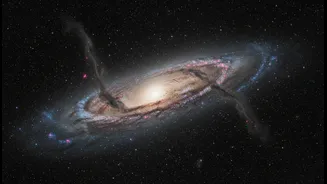
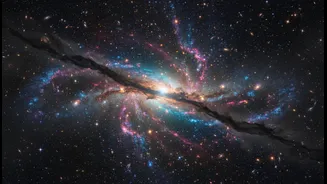
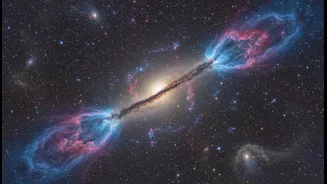
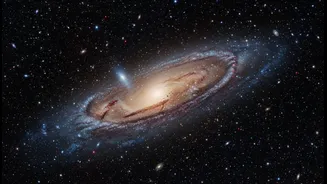
Located a relatively close 11 to 13 million light-years away, Centaurus A is not your average galaxy. It's the result of a colossal merger between a large elliptical galaxy and a smaller spiral galaxy that happened around two billion years ago. This cosmic
crash has left Centaurus A with a peculiar, warped structure, threaded with dramatic dark lanes of dust. At its heart lies a supermassive black hole, one of the closest active ones to Earth, that is furiously feeding on the leftover gas and dust from the collision. This activity makes Centaurus A a perfect natural laboratory for understanding how galaxies and their central black holes grow and evolve together.
Webb's Infrared Superpower
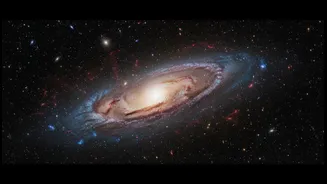
For decades, astronomers have studied Centaurus A, but its most intimate secrets were hidden behind a thick veil of cosmic dust. Telescopes like Hubble, which see primarily in visible light, were unable to pierce through this dusty shroud. Even the infrared Spitzer Space Telescope could only resolve large-scale structures. This is where Webb's genius lies. Its powerful Mid-Infrared Instrument (MIRI) and Near-Infrared Camera (NIRCam) are designed to see the universe in wavelengths of light that can pass through dense dust clouds. This allows Webb to do what no telescope has done before: see the galaxy's core star by star. What looks like graininess in the new images is actually a dense field of millions of individual stars, each a data point in the galaxy's history.
Galactic Archaeology in Action
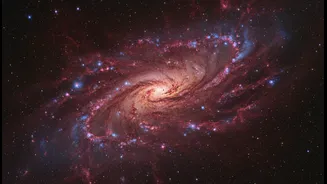
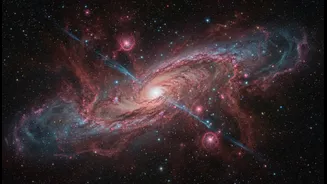
With this new, unprecedented clarity, scientists can now engage in a kind of 'galactic archaeology'. By studying the individual stars, they can reconstruct a timeline of events. They can pinpoint when the first stars formed, when there was a lull in activity, and identify the new burst of star formation triggered by the galactic collision. The image reveals glowing red points, which are stellar nurseries where new stars are forming from the abundant dust and gas, as well as older stars shedding their material back into space. This detailed view allows scientists to trace the complete life cycle of stars within a galaxy that has undergone such a dramatic transformation.
The Black Hole's Fiery Secret
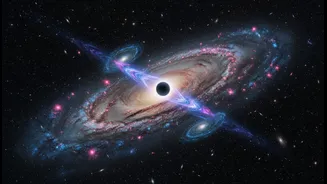
The new image also provides stunning insight into the relationship between the supermassive black hole and its host galaxy. As the black hole feeds, it releases enormous amounts of energy, launching powerful jets of material far out into space. Webb's data reveals fast-moving ionized gas being pushed outwards by this activity. At the same time, it shows a warped disk of warmer gas rotating near the galaxy's heart. This provides direct evidence of the cosmic tug-of-war where a black hole can both trigger intense star formation by compressing gas, and simultaneously 'kill' a galaxy by blasting away the very material needed to form new stars. The intricate, glowing shapes of dust, including a mysterious 'S' shaped feature, pose new questions that will keep astronomers busy for years.
Four Years of Changing Astronomy
This breathtaking view of Centaurus A is a fitting anniversary gift, symbolizing four years of groundbreaking science from the Webb telescope. Since its first images were released, Webb has exceeded all expectations, peering into the atmospheres of exoplanets, discovering the earliest known galaxies, and revealing the universe in a light never seen before. Each new image builds on the foundation of previous discoveries, with Webb expanding on the work of predecessors like Hubble and Spitzer. The choice of Centaurus A highlights the telescope's unique ability to unravel complex cosmic histories, transforming our understanding of the universe one galaxy at a time.