




The Artemis Vision
Under the ambitious Artemis program, NASA is planning to do more than just leave footprints on the Moon; the goal is to establish a sustained human presence. This long-term settlement, dubbed the Moon Base, is envisioned near the lunar South Pole, a strategic
location thought to harbor water ice in its permanently shadowed craters. But a sustainable outpost requires infrastructure: landing pads, habitats, power systems, and radiation shielding. The multi-phase plan involves a progressive build-up of capabilities, starting with robotic missions to scout, test, and prepare the ground before astronauts begin longer stays. This isn't about planting a flag; it's about building a foothold for humanity's future in the solar system, with the Moon serving as a crucial proving ground for eventual missions to Mars.
The Ultimate Construction Challenge
Building on the Moon presents a set of challenges far beyond any terrestrial construction project. There's no atmosphere to protect against micrometeorite impacts and extreme radiation. Temperatures fluctuate wildly, from scorching heat to cryogenic cold. Then there is the lunar dust, or regolith, a fine, abrasive material that can damage equipment and pose health risks to astronauts. Perhaps the biggest hurdle is logistics. The cost of launching every nail, screw, and structural beam from Earth is astronomically high. Furthermore, communication delays make real-time remote control of machinery slow and inefficient. These obstacles make it impractical, and dangerous, to rely solely on human astronauts for construction work.
A New Robotic Workforce
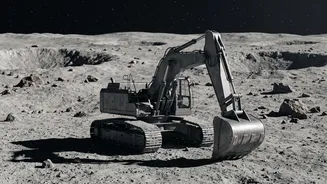
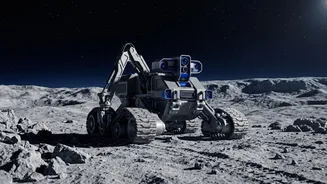
To solve these problems, NASA is turning to autonomous robots. These machines can operate in the hazardous lunar environment around the clock without life support, preparing worksites long before humans arrive. The focus is on autonomy because direct control from Earth is hampered by signal delays. Instead, these robots will be given objectives and will need to figure out how to achieve them on their own, a critical capability for ensuring missions can continue even if communication is temporarily lost. This robotic vanguard represents a fundamental shift, moving from simple remote-controlled explorers to sophisticated, decision-making collaborators that will lay the physical and operational foundation of the Moon Base.
Teamwork Makes the Dream Work
Two key projects exemplify NASA's strategy: CADRE and LINA. The CADRE (Cooperative Autonomous Distributed Robotic Exploration) project involves a team of shoebox-sized rovers. These small robots will work together as an autonomous team, communicating via a mesh network to explore and map areas, even in hard-to-reach places like craters. By coordinating their actions without step-by-step human commands, they will demonstrate the kind of multi-robot system needed for complex survey and site preparation tasks. A tech demonstration for CADRE is slated to land on the Moon in 2026 to test its capabilities in the real lunar environment.
Building with Moon Dust
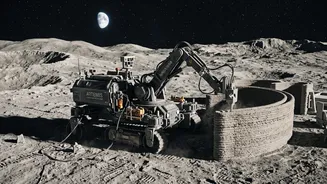
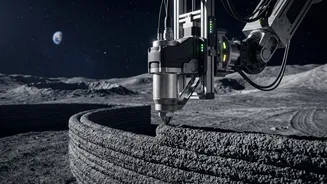
The second piece of the puzzle is using local resources, a concept known as in-situ resource utilization (ISRU). Project LINA (Lunar Infrastructure Asset), a collaboration between NASA and the architectural firm AI SpaceFactory, aims to do just that. The vision is for autonomous robots to 3D-print structures using a composite material made from native lunar regolith mixed with a polymer binder brought from Earth. These habitats would feature a vaulted design with a thick outer layer of regolith piled on top, providing crucial protection from radiation and micrometeorites. This method drastically reduces the mass that needs to be launched from Earth, making a large, permanent base economically feasible. Prototypes are already being tested in vacuum chambers that simulate the harsh conditions of the Moon.