




The Sun's Unpredictable Rhythm
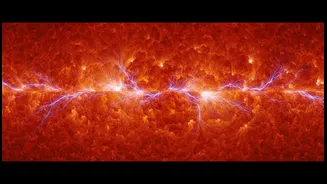
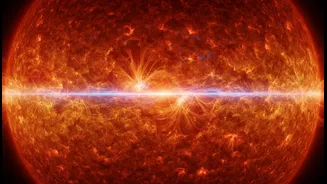
Our star isn't the perfectly stable ball of fire it might seem. It operates on a roughly 11-year cycle of activity. During a solar minimum, the Sun is relatively calm. But as it ramps up to a solar maximum, its surface becomes a chaotic mess of sunspots,
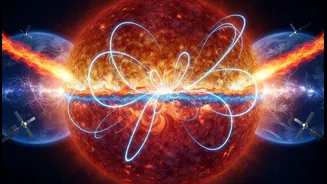
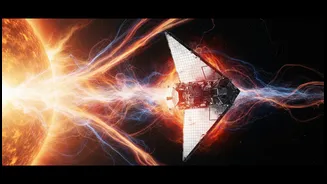
solar flares, and enormous eruptions of plasma called coronal mass ejections (CMEs). When these eruptions are aimed at Earth, they can have serious consequences. They can disrupt our satellite communications, damage power grids, and pose a risk to astronauts. Understanding this cycle isn't just an academic exercise; it's crucial for protecting the technology we rely on every day. Scientists can observe the cycle, but predicting its strength and specific behaviour remains a major challenge. It’s like knowing winter is coming, but not knowing how severe the storms will be.
A Journey to the Sun's Interior
To understand the Sun's surface activity, we have to look deep inside. The Sun has distinct layers, much like the Earth. At its heart is the core, where nuclear fusion generates immense energy. This energy travels outwards through the radiative zone, a dense region where energy is passed from particle to particle over millions of years. The outermost 30% of the Sun's interior is the convection zone. Here, hot plasma rises, cools, and sinks in a churning, boiling motion, similar to a pot of water on a stove. It is this convective motion that is visible on the solar surface. But between the calm radiative zone and the turbulent convection zone lies a remarkably thin, critical boundary layer: the tachocline.
Meet the Tachocline: The Sun's Engine Room
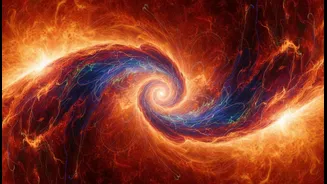
The tachocline is a region of incredible shear. The radiative zone below it rotates as a solid body, like a spinning top. But the convection zone above it rotates differentially, meaning the Sun's equator spins faster than its poles. The tachocline is the thin boundary—less than 5% of the Sun's radius—where these two drastically different rotation speeds meet. This clash of motion creates a tremendous amount of stress and shear. First theorised in 1992, its existence was confirmed by helioseismology, the study of sound waves moving through the Sun. Scientists believe this high-shear environment is the perfect place to generate and amplify magnetic fields.
The Dynamo Theory: A Cosmic Generator
This process of generating a magnetic field is explained by what's called the dynamo theory. In simple terms, a dynamo converts kinetic energy (motion) into magnetic energy. The theory suggests that the powerful shearing motion in the tachocline takes the Sun's existing weak magnetic fields (known as poloidal fields) and stretches, twists, and amplifies them into powerful, rope-like magnetic bands (toroidal fields). These powerful magnetic bands are stored in the tachocline. When they become unstable, they can rise through the convection zone and burst through the surface, creating the sunspots and active regions that drive solar flares and CMEs. The tachocline is therefore considered the 'seat' of the solar dynamo—the engine driving the entire 11-year solar cycle.
The Challenge of Modelling a Star
If the tachocline is so important, why can't we just observe it directly? The problem is that it's buried deep inside a star. Everything we know about it comes from indirect measurements, primarily through helioseismology, and complex computer simulations. These models are incredibly difficult to build. They must account for the physics of magnetohydrodynamics—the interplay of moving plasma and magnetic fields—under extreme conditions that can't be replicated on Earth. The precise thickness, shape, and properties of the tachocline are still areas of active research. Small variations in these parameters within the models can lead to very different predictions about the solar cycle. Accurately modelling the tachocline is the critical missing piece needed to move from simply observing the solar cycle to truly forecasting it.
Why Better Forecasts Matter
A breakthrough in modelling the tachocline would revolutionise space weather forecasting. Instead of just a few days' warning for a coming solar storm, we might be able to predict the overall intensity of a solar cycle years in advance. This would give satellite operators, power grid managers, and space agencies valuable time to prepare for potential disruptions. It would allow us to better protect our vital infrastructure in space and on the ground. Understanding the Sun's dynamo also has implications beyond our own solar system, helping us understand the magnetic activity and 'space weather' around other stars and their exoplanets. The secrets locked away in the Sun's tachocline are not just about our star, but about how stars across the universe work.