

The Foundation: Mastering Basic Tree Pose
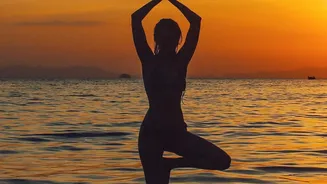
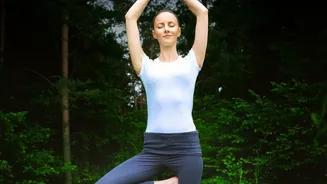
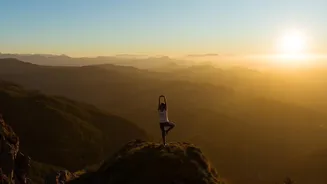
Vrksasana teaches you to feel rooted and expansive at the same time. It improves balance, enhances focus, and strengthens the muscles in your standing leg, from your foot to your hip. Begin in Mountain Pose (Tadasana), standing tall with your feet together
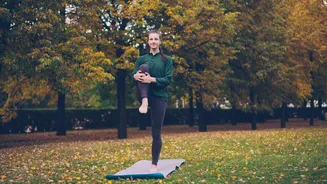
or hip-width apart. Shift your weight onto your left foot, grounding down through all four corners. Find a fixed point to gaze at in front of you—your drishti—to help maintain stability. Bend your right knee and place the sole of your right foot on your inner left ankle, calf, or upper thigh. Actively press the foot into the leg and the leg back into the foot to create a stable connection. A crucial point is to always avoid placing your foot directly on your knee joint, as this can cause injury. Bring your hands to a prayer position at your heart. Keep your hips level and your spine long. Hold for 5 to 10 deep breaths before gently releasing and repeating on the other side.
Variation 1: The Supportive Kickstand
If you're new to balancing or feeling a bit wobbly, this is the perfect place to start. This modification allows you to build confidence and strength without the pressure of a full balance. From Mountain Pose, shift your weight to your standing leg. Instead of lifting your other foot completely, simply turn the knee out to the side and rest the toes of your bent leg on the floor, with your heel pressing gently against your standing ankle. This creates a 'kickstand' that provides stability while you get used to the alignment. Keep your hands at your heart or on your hips and focus on keeping the standing leg strong and the hips square. This variation still provides many benefits, including opening the hip and building focus.
Variation 2: Arms as Branches
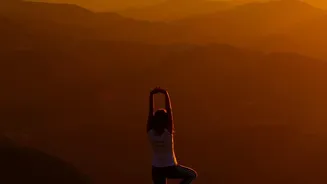
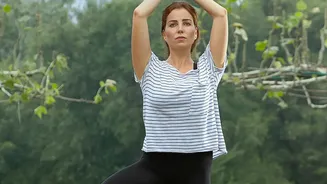
Once you feel stable in the basic pose, you can play with your arm position to change the pose's expression and challenge. Extending your arms overhead like the branches of a tree is a classic next step. From your stable Tree Pose, inhale and sweep your arms out to the sides and up toward the sky. You can keep your palms shoulder-width apart or press them together. Relax your shoulders away from your ears, even as you reach upward. This variation stretches the shoulders and chest, lengthens the spine, and adds a slight balance challenge. For a different feel, try 'windy tree' by gently swaying your arms and upper body, which tests your core stability even more.
Variation 3: Tree with a Side Bend
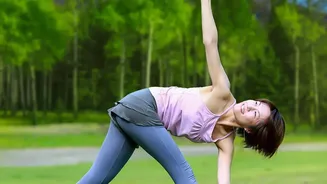
This variation introduces a lateral stretch, lengthening the side body while maintaining your one-legged foundation. From your Tree Pose with arms overhead, grab your right wrist with your left hand. On an exhale, gently bend your torso to the left, creating a graceful arc with your body. Keep your standing leg strong and rooted to prevent your hips from swaying out. This move deepens the stretch along the right side of your torso and challenges your balance in a new plane of movement. Breathe into the stretch for a few breaths, return to the center on an inhale, and then switch sides.
Variation 4: Twisted Tree
Adding a twist to your Tree Pose challenges your core and balance significantly while promoting spinal mobility. Settle into your basic Tree Pose with hands in prayer at your heart. Keeping your hips squared forward and your lower body stable, begin to rotate your upper body toward your bent-knee side. For instance, if your right knee is bent, twist to the right. The key is to isolate the twist in the upper and mid-spine, keeping the standing leg and pelvis as still as possible. This variation requires immense focus and core engagement. Hold for a few breaths, feeling the rotation, before gently unwinding and repeating on the opposite side.
Variation 5: Half-Lotus Tree
For experienced practitioners with open hips, the Half-Lotus variation offers a deeper hip-opening stretch. Instead of placing your foot on the inner thigh, carefully draw the top of your foot to the opposite hip crease, allowing your knee to point down toward the floor. This is Ardha Padmasana (Half Lotus) in Vrksasana. This is an advanced variation that should only be attempted if you have the necessary hip flexibility and no knee pain. It intensifies the stretch in the hip and quadriceps of the bent leg. If this is accessible, you can explore bringing one or both hands behind your back to bind, catching the toes of your lotus foot.