





A Tradition Set in Time
The construction of the chariots is not a spontaneous event but a deeply rooted tradition governed by the Hindu lunar calendar. The process officially kicks off on Akshaya Tritiya, an auspicious day in April or May, which also marks the start of the Chandan
Yatra festival. However, preparations begin even earlier, on Vasant Panchami (January/February), with the consecration of the first logs of wood. This sacred timeline ensures that the divine vehicles are ready for the grand journey in June or July. For nearly two months, the area in front of the King's Palace, known as the Ratha Khala, transforms into a bustling, open-air workshop where ancient skills come to life. The entire 58-day construction schedule is a meticulously planned affair, blending spiritual rituals with artisanal labour.
The Quest for Sacred Timber
The very soul of the chariots lies in the wood they are made from. Every year, new chariots are built, requiring a massive supply of specific timber. Traditionally, more than 800 logs from trees like Phasi, Dhausa, and Asana are sourced from the forests of Dasapalla and Nayagarh in Odisha. These are not just any trees; they must be perfectly straight and meet specific dimensions. The selection process itself is a ritual, where temple representatives identify and worship the trees before they are felled. The Odisha government supplies this timber free of cost. After being transported to Puri, the logs are ceremonially cut at a designated sawmill on Ram Navami, another holy day, before being delivered to the master craftsmen. In recent years, due to environmental changes, an increasing number of logs are being donated by private landowners, adding a new layer of community participation to this ancient practice.
Generations of Divine Craft
The construction is entrusted to a dedicated team of about 200 artisans from specific sevayat (servitor) families who have held these hereditary rights for centuries. Astonishingly, they use no modern machinery, no formal blueprints, and no written manuals. All knowledge is passed down orally and through apprenticeship from one generation to the next. The main group, the Maharana sevayats, are the master carpenters (Biswakarmas) who lead the structural work. They are assisted by the Bhoi sevayats, who serve as labourers, transporting the heavy logs. The Kamara sevayats, or blacksmiths, forge every single nail, clamp, and iron fitting by hand in a temporary smithy. Their tools are traditional, and their measurements rely on ancient units like the 'haat' (the length of a forearm).
Three Chariots, One Divine Purpose
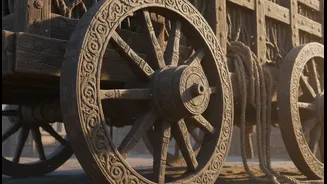
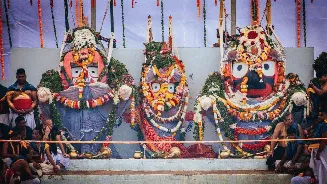
Three distinct chariots are built, each a towering temple-like structure with its own unique identity. Lord Jagannath's chariot, Nandighosha, is the largest, standing about 45 feet tall with 16 wheels, and is draped in a brilliant red and yellow canopy. Lord Balabhadra's chariot, Taladhwaja, is nearly as tall, with 14 wheels and a canopy of red and green or blue. Goddess Subhadra's chariot, Darpadalana, stands at around 43 feet, has 12 wheels, and is covered in red and black fabric. Each chariot is meticulously assembled piece by piece, starting with the massive wheels. The platform, walls, and the towering superstructure are then raised, all held together by the hand-forged ironmongery from the Kamara sevayats.
Adorned in Celestial Splendour
In the final weeks, the chariots are transformed from wooden skeletons into mobile works of art. The Chitrakar sevayats (hereditary painters) take over, decorating the structures with traditional motifs, deities, and vibrant colours. They paint the wooden horses—four for each chariot—and the charioteers, Matali and Daruka. Simultaneously, the Darji sevayats (tailors) expertly stitch the massive fabric canopies, which often feature the famous applique work of Pipli. Finally, ropes made of coconut fibre are attached, ready for the thousands of devotees who will pull the chariots on the day of the Yatra, considering it an act of great religious merit. Once completed, the chariots are brought to the temple's Lion Gate, awaiting the deities.