






A Stage Set Among Giants
Ladakh, often called the ‘Land of High Passes,’ is a landscape of stark, breathtaking beauty. Nestled between the Karakoram and Himalayan ranges, its barren mountains are punctuated by patches of impossible green and ancient Buddhist monasteries (gompas)
that cling to cliffsides. It is in these sacred courtyards that one of the region's most profound cultural experiences unfolds. The annual monastery festivals are not mere tourist events; they are the spiritual lifeblood of the community. Locals, dressed in their finest traditional attire (gonchas), gather from remote villages, creating an atmosphere that is both festive and deeply reverent. The backdrop of snow-dusted peaks and azure skies only adds to the sense that you are witnessing something truly otherworldly.
The Ritual of the Cham Dance
At the heart of these festivals are the Cham dances. Far more than a performance, Cham is a form of active meditation and a powerful religious ritual. Performed by monks, these masked dances are a sacred tradition within Tibetan Buddhism. Each movement is codified, each gesture packed with symbolic meaning. The dances re-enact stories about the triumph of good over evil, the life of important Buddhist saints like Padmasambhava (Guru Rinpoche), and the subjugation of demons that obstruct the path to enlightenment. The dancers move in slow, deliberate circles, their heavy costumes swirling around them as they transform the monastery courtyard into a divine mandala, a spiritual map of the cosmos.
Masks of Gods and Demons
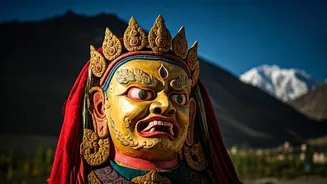
The most striking feature of the Cham is undoubtedly the masks. Intricately carved from wood or made from papier-mâché, these larger-than-life masks are terrifying, serene, and awe-inspiring all at once. They represent a pantheon of Buddhist deities, both benevolent and wrathful. The fierce-looking figures with bulging eyes and bared fangs are not evil; they are Dharma protectors (Dharmapalas), whose fearsome appearance is meant to vanquish negativity and protect the faithful. Other masks may represent animals, historical figures, or clowns who provide comic relief while imparting moral lessons. Each mask is considered a sacred object, believed to be imbued with the spirit of the deity it represents. To witness them in motion is to see ancient mythology come alive.
The Resonant Sound of the Mountains
The dances are inseparable from their powerful soundtrack. The air vibrates with the deep, resonant drone of the dungchen, long copper horns that can be several metres in length. Their sound, said to mimic the call of elephants, echoes across the valleys. This is punctuated by the rhythmic clashing of cymbals (rolmo), the steady beat of large drums, and the piercing notes of the gyaling, a type of oboe. This is not music in the Western sense of melody, but a sonic landscape designed to alter consciousness and facilitate a spiritual state. It is hypnotic, at times dissonant, and completely immersive, pulling spectators into the ritual’s sacred rhythm.
More Than Just a Spectacle
While visually spectacular, the true importance of a Ladakh festival lies in its spiritual purpose. For the monks, performing the Cham is a duty and a form of spiritual practice. For the laypeople who gather to watch, it is an opportunity to receive blessings (darshan), reaffirm their faith, and witness the fundamental Buddhist principle of impermanence. The festivals, such as the famous Hemis Tsechu held in honour of Padmasambhava, serve to spiritually cleanse the region and its people, ensuring prosperity and warding off misfortune for the year ahead. They are a living bridge connecting the community to its history, its faith, and the very fabric of its identity.