



The Ultimate Road Trip Problem
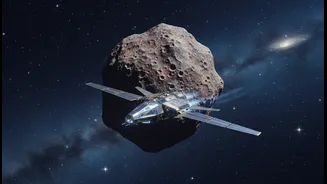
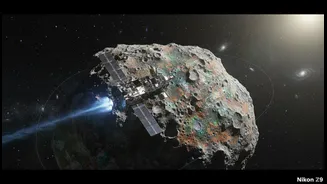
Imagine trying to hit a target the size of a football stadium, moving at thousands of kilometres per hour, from millions of kilometres away. Now, imagine that target is a lumpy, irregularly shaped rock tumbling through the void of space. This is the fundamental
challenge of asteroid science. Unlike planetary missions where targets are massive, the low gravity of asteroids means a tiny miscalculation can cause a spacecraft to either fly past its target or crash into it. These missions require a level of accuracy that pushes the boundaries of what is technologically possible, creating a deep and symbiotic relationship between the scientific “why” and the navigational “how.”
A Celestial Positioning System
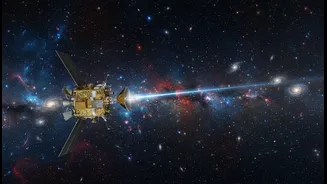
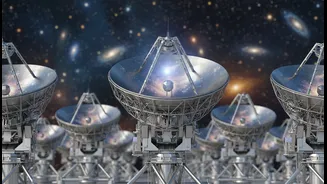
For most of a spacecraft's journey to an asteroid, mission controllers rely on a global system of giant radio antennas called the Deep Space Network (DSN). Strategically placed in California, Spain, and Australia, these massive dishes ensure we can always communicate with our deep space explorers as the Earth rotates. By sending and receiving signals, engineers can track a spacecraft's position and velocity with incredible precision. This network is the indispensable link, the lifeline that guides a mission across the solar system and brings back precious data. It forms the backbone of interplanetary navigation, but as a spacecraft gets closer to its target, it needs to start seeing for itself.
Seeing Is Believing
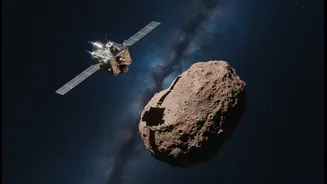
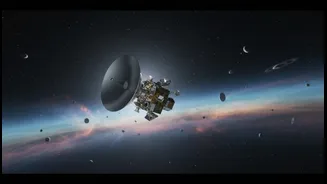
In the final stages of approach, relying solely on signals from Earth isn't enough. The time delay—minutes or even hours for a round trip—means the spacecraft must make decisions on its own. This is where autonomous optical navigation comes in. Using advanced cameras, the spacecraft takes pictures of the asteroid against the backdrop of distant stars. Onboard software then identifies the target, distinguishes it from any nearby moons, and makes real-time course corrections. NASA's DART mission, which successfully impacted the asteroid moonlet Dimorphos, used its DRACO camera and SMART Nav system to autonomously guide itself to a collision millions of miles from Earth. Without this ability to see and react on its own, the mission would have missed its target.
A Case Study in Accuracy
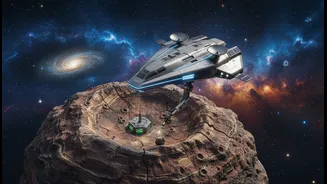
Perhaps no mission better illustrates this synergy than OSIRIS-REx. Its goal was to collect a sample from Bennu, an asteroid with a surface so rocky and hazardous that the final landing zone was just 16 meters in diameter. To achieve this, the spacecraft used a system called Natural Feature Tracking. It compared live images during its descent to a pre-loaded catalogue of boulders and craters, allowing it to navigate to the precise spot while dodging hazards. The entire sample collection maneuver was performed autonomously, as the 20-minute communication delay made real-time human control impossible. It was a stunning display of precision navigation driven entirely by the demands of science.
The Scientific Jackpot and Future Frontiers
So why go to all this trouble? Asteroids are more than just space rocks; they are time capsules from the formation of our solar system 4.5 billion years ago. Studying them can help us understand how planets formed and how water and the building blocks of life may have been delivered to Earth. Furthermore, missions like DART prove that kinetic impactors are a viable strategy for planetary defense, should a dangerous asteroid ever be found on a collision course with our planet. As technology advances, future missions will rely even more on autonomous AI, enabling spacecraft to make their own scientific decisions on missions to the outer solar system where communication delays are even greater. The drive to explore these ancient objects is not just answering questions about our past; it is building the technology that will define the future of exploration.