


The Moon's Most Valuable Resource
For decades, the Moon was seen as a completely dry, barren world. But a series of orbital missions and impact probes have confirmed the presence of water ice, particularly concentrated at the poles. This isn't just about giving astronauts something to
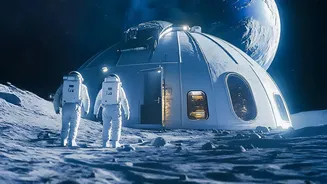
drink. Water (H2O) is a game-changing resource for space exploration because it can be split into its core components: hydrogen and oxygen. Oxygen provides breathable air for habitats, while liquid oxygen and liquid hydrogen are a potent combination for rocket propellant. The ability to manufacture air and fuel on the Moon—a concept known as in-situ resource utilization (ISRU)—would drastically reduce the cost and complexity of missions, as these heavy supplies would no longer need to be launched from Earth. This transforms the Moon from a temporary campsite into a true planetary outpost.
Why the South Pole?
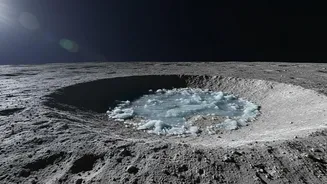
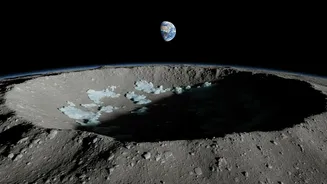
The secret to the Moon's water lies in its unique polar environment. Because the Moon's axis has only a very slight tilt, the floors of some deep craters near the North and South Poles are never touched by direct sunlight. These areas are known as permanently shadowed regions (PSRs), where temperatures can plummet to below minus 160 degrees Celsius. In these extreme cold traps, water ice that arrived via comets or asteroids over billions of years can remain stable and preserved, mixed in with the lunar soil, or regolith. While other volatiles like carbon dioxide have also been detected, it is the promise of vast quantities of water ice that has made the lunar South Pole the primary target for NASA's Artemis program and future crewed landings.
The Robotic Prospector
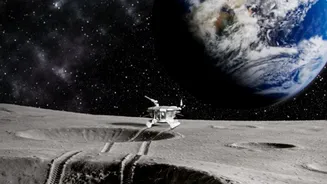
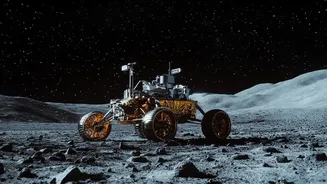
Before astronauts can set up a lunar gas station, we need to know exactly where the best resources are. This is where robotic mapping missions come in. The most crucial of these is NASA's Volatiles Investigating Polar Exploration Rover, or VIPER. This golf-cart-sized robot is designed to navigate the harsh terrain of the South Pole, creating the first-ever resource maps of an extraterrestrial body. Equipped with a suite of instruments, including a neutron spectrometer to detect water below the surface and a one-meter drill, VIPER will analyze the concentration, depth, and purity of the ice deposits. By prospecting in different soil environments, it will identify the most promising locations for future extraction, determining whether the ice is in accessible chunks or fine grains mixed with soil.
From Frozen Regolith to Rocket Fuel
Extracting the ice is only the first step. The proposed methods involve heating the icy regolith to sublimate the water, turning it directly into vapor. This vapor would be captured under a dome and then funneled into a cold trap, where it re-freezes into purer ice. Once collected, the water is purified and then processed through electrolysis, which uses electricity to split the water molecules into hydrogen and oxygen gas. These gases must then be cooled to extremely low temperatures to be stored as cryogenic liquids—the same form of propellant used by many modern rockets. Projects like NASA's CryoFILL are already testing the technologies needed to liquefy and store these propellants on the lunar surface, perfecting the process for future missions.
Challenges on the Lunar Frontier
While the promise is enormous, the engineering challenges are significant. The permanently shadowed craters are not only dark but also incredibly cold—cold enough to make machinery brittle. The terrain can be rugged and difficult for rovers to navigate. Furthermore, the ice is not expected to be in clean, thick sheets like a frozen lake on Earth. Instead, it is likely mixed with soil in varying concentrations, which could make the extraction process energy-intensive and complex. Building and operating mining and processing equipment in a vacuum, with extreme temperature swings and abrasive lunar dust, will require a new generation of robust technology designed to withstand one of the most hostile environments in the solar system.