


The Physics of a Sunbeam's Push
At the heart of solar sailing is a mind-bending but fundamental principle of physics: light has momentum. While individual light particles, called photons, have no mass, they do carry momentum as they travel. When a photon bounces off a highly reflective
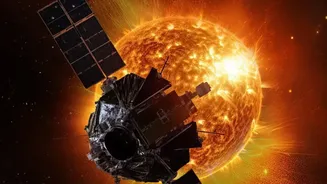
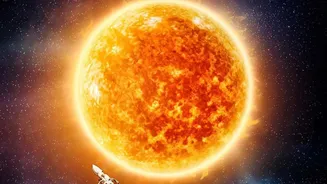
surface, it transfers that momentum, imparting a tiny push. One photon's push is infinitesimally small, but the Sun emits a ceaseless, astronomical number of them. In the vacuum of space, with no friction to slow things down, these continuous tiny pushes add up. Over time, this constant, gentle acceleration allows a spacecraft to build up tremendous velocity without burning a single drop of propellant. It's not the solar wind, which is a stream of charged particles, but the pure pressure of light itself that does the work.
Designing a Craft Made of Light
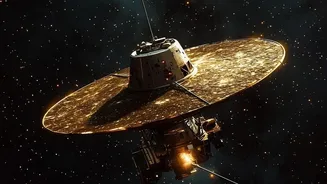
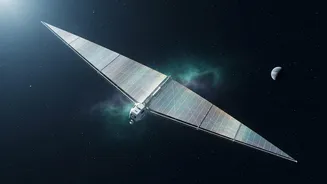
To catch these photons, a solar sail must be enormous in area but incredibly low in mass. Think of a material thinner than a human hair but stretched over an area the size of a small apartment or even a basketball court. The sails are typically made from a lightweight polymer like Mylar or Polyimide, coated with a layer of aluminum to make them as reflective as a mirror. The challenge lies in deploying these delicate, massive structures in space. Engineers have developed innovative, lightweight booms, often made of advanced carbon fiber composites, that unspool from a compact package to stretch the sail into its final, massive shape. NASA's Advanced Composite Solar Sail System (ACS3), launched in 2024, is a key mission testing these next-generation composite booms, which are lighter and more stable than previous metal designs.
Putting the Theory into Practice
Solar sailing has moved from theory to proven technology. The first spacecraft to successfully demonstrate controlled solar sailing in interplanetary space was Japan’s IKAROS mission, launched in 2010. It successfully flew by Venus, using its 196-square-meter sail to adjust its course and increase its speed by approximately 400 meters per second over its mission. More recently, The Planetary Society's crowdfunded LightSail 2 mission, which operated from 2019 to 2022, proved that a small, low-cost CubeSat could use a solar sail to change its orbit around Earth, raising its highest point by several kilometers using only sunlight. These missions provided invaluable data and paved the way for more ambitious projects. NASA's ACS3, which successfully deployed its 80-square-meter sail in 2024, is now testing the technologies needed for even larger and more capable sails.
A New Definition of 'Record Speeds'
The phrase "record speeds" requires some context. A solar sail does not have the explosive, immediate thrust of a chemical rocket. Its acceleration is gentle, sometimes measured in millimeters per second. However, its advantage is persistence. A chemical rocket burns its fuel in minutes, coasting for the rest of its journey. A solar sail accelerates continuously for weeks, months, or even years. For long-duration missions into deep space, this unending push allows a solar sail-powered craft to eventually reach higher speeds than a conventional probe that had a faster start. It's the difference between a drag racer and a marathon runner. While the Parker Solar Probe currently holds the overall spacecraft speed record, its velocity comes from a powerful rocket launch and a gravitational slingshot around the Sun. The "record" for solar sails is their ability to achieve significant velocity change with no onboard propellant, a revolutionary capability for deep-space exploration.
The Future of Interstellar Travel
The true promise of solar sails lies in the future. By eliminating the need for heavy fuel, they enable lighter, cheaper missions that can travel for longer and go to places previously out of reach. Missions are being designed that could use solar sails to provide early warnings for solar storms by stationing themselves in unique orbits closer to the Sun. For even more ambitious travel, the concept extends beyond the Sun. Scientists envision using powerful, ground-based lasers to push ultra-lightweight sails, potentially accelerating them to a significant fraction of the speed of light for interstellar journeys to nearby stars. While such applications are still on the horizon, the technology being proven today by missions like LightSail and ACS3 is laying the critical groundwork for a future where humanity can truly sail the cosmic ocean.