





The Initial Face-Off
At first glance, the choice seems straightforward. Quinoa has a well-earned reputation as a nutritional powerhouse. It’s a complete protein, meaning it contains all nine essential amino acids, and it's naturally rich in fiber, iron, and magnesium. Puffed
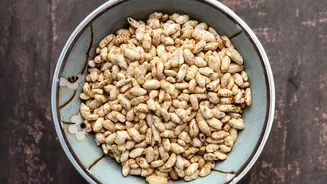
quinoa is often marketed as a more nutrient-dense alternative to traditional puffed grains. On the other hand, puffed rice is celebrated for being exceptionally light and low in calories. It's a go-to for those seeking a quick, crunchy, and airy snack that won't weigh them down. It serves as a familiar base for everything from breakfast cereals to the beloved bhel puri. Based on reputation alone, many health-conscious shoppers would likely reach for the quinoa puffs, assuming they are the superior choice in every scenario.
A Straight Comparison: Gram for Gram
To get an accurate baseline, let's ignore serving suggestions and compare both snacks purely by weight. Per 100 grams, quinoa puffs generally offer more protein and fiber than puffed rice. Unflavored quinoa puffs can contain around 14 grams of protein and 7 grams of fiber. By contrast, 100 grams of plain puffed rice provides roughly 6 to 8 grams of protein and significantly less fiber, often under 2 grams. Calorie-wise, they are more similar than you might think when measured this way. Both typically fall in the range of 350 to 400 calories per 100 grams, depending on the specific brand and preparation. On a pure weight basis, quinoa puffs take the lead on key nutrients like protein and fiber, reinforcing their healthy image.
The Serving Size Deception
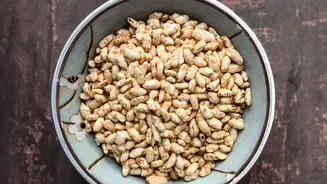
Here is where the comparison gets complicated, and it's the most important lesson for any savvy snacker. We don't eat snacks by the gram; we eat them by the bowlful or the cup. This is a measure of volume, not weight. Because puffed rice is incredibly light and airy, a cup of it weighs very little—only about 14-15 grams. In stark contrast, quinoa puffs are much denser. A single cup of quinoa puffs can weigh around 70 grams. This means that for the same volume—one cup—you are consuming five times the physical amount of quinoa puffs by weight compared to puffed rice. This massive difference in density completely changes the nutritional math when you look at a typical serving.
The Real-World Bowlful
Let’s re-run the numbers for a single-cup serving. That light, airy cup of puffed rice, weighing only 14 grams, contains about 55-60 calories and just 1 gram of protein. Suddenly, it looks like an extremely low-calorie option. Meanwhile, that one-cup serving of denser quinoa puffs, weighing 70 grams, contains around 280 calories and 10 grams of protein. When compared by the bowl, puffed rice is the undisputed low-calorie winner, while quinoa puffs deliver a much more substantial amount of protein and energy. So, is one 'better'? It entirely depends on your goal. For a light, low-impact snack to satisfy a craving for crunch, puffed rice is a great choice. For a more filling, protein-rich snack to fuel your energy levels and keep you full longer, quinoa puffs are the clear winner.
Beyond Calories and Protein
Nutrition isn't just a numbers game. Satiety—the feeling of fullness—is a crucial factor. The higher protein and fiber in a serving of quinoa puffs will likely keep you feeling full for much longer than the light carbohydrates in puffed rice. This can help prevent overeating later. Furthermore, the type of carbohydrates matters. Quinoa has a lower glycemic index than white rice, meaning it's less likely to cause a rapid spike in blood sugar. Finally, consider what you add to your snack. Milk, fruit, nuts, or spices all contribute to the final nutritional profile. A bowl of puffed rice with fresh berries can be a wonderfully light and nutritious breakfast, while quinoa puffs mixed into yogurt provide a powerful, protein-packed start to the day.