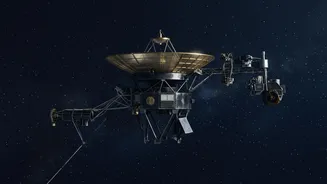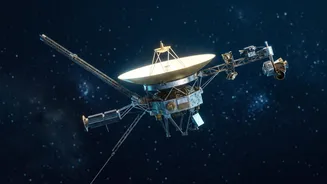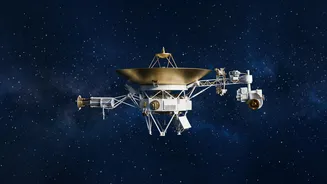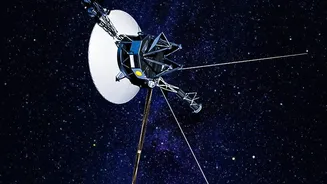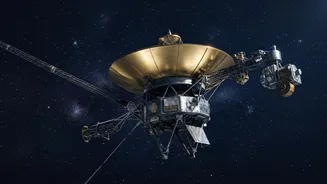




Floating in the silence of interstellar space, Voyager 1 is a testament to human curiosity. After a recent communications scare was resolved by sheer ingenuity, our farthest messenger is now approaching a milestone that redefines distance.
A Signal From the Void
Humanity’s most
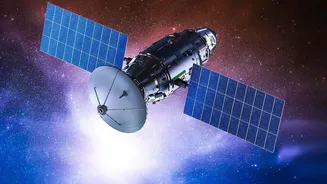
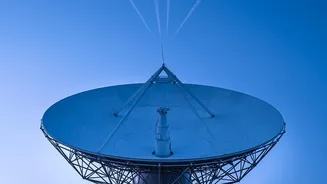
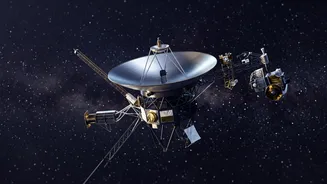
distant object, the Voyager 1 spacecraft, is now so far away that its signals take nearly a full day to reach us. This immense distance turned a recent technical glitch into a profound challenge. For roughly 48 hours in October 2026, the probe went silent, missing two scheduled check-ins with NASA’s Deep Space Network. The silence was unnerving. When the signal unexpectedly returned on its own, engineers discovered the spacecraft had automatically switched to a backup set of thrusters, a protective measure it had never taken before in its nearly 50 years of flight. While this immediate crisis was averted, it underscored the immense difficulty of operating a vintage 1977 spacecraft billions of miles from home.
An Interstellar Detective Story
The October 2026 incident was a new scare, but it came after a much more complex problem that began in November 2023. For five months, Voyager 1 sent back streams of gibberish. The spacecraft was still receiving commands, but its replies were meaningless. Engineers at NASA's Jet Propulsion Laboratory (JPL) embarked on a painstaking diagnostic process, hampered by a 45-hour round-trip communication delay. By March 2024, they traced the issue to a single faulty memory chip in the Flight Data Subsystem (FDS), the computer that packages all science and engineering data for its long journey to Earth. About 3% of the FDS memory was corrupted, rendering its data packages unreadable. The cause remains uncertain—it could have been a random hit from a high-energy particle or simply the wear and tear of 46 years in space.
A Digital Lifeline Across Billions of Miles
Fixing a broken chip from over 15 billion miles away is impossible. Instead, the JPL team devised an incredibly clever workaround. Since there was no single empty block of memory large enough to hold the broken code, they decided to slice it into sections. They then painstakingly tucked these smaller code fragments into various free spaces within the FDS memory. The final step was to update the main program so it knew where to find these scattered pieces to run its data-packaging sequence correctly. On April 18, 2024, they sent the patch across the solar system. After a nail-biting 45-hour wait, a clear, readable signal returned, confirming the audacious fix had worked and science data could once again flow from interstellar space.
A New Milestone: One Light-Day From Home
With communications restored, Voyager 1 is now approaching another historic achievement. On November 18, 2026, the spacecraft will become the first human-made object to reach a distance of one light_day from Earth. A light_day is the distance light travels in $24$ hours, a staggering $16.1$ billion miles (or about $25.9$ billion kilometers). This milestone has a practical impact: a command sent from Earth will take a full $24$ hours to reach the probe, and its reply will take another $24$ hours to return. This two_day communication lag further complicates the challenge of keeping the aging explorer alive as its plutonium power source slowly dwindles.
The Golden Record's Endless Journey
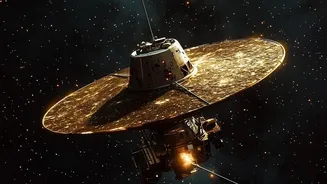
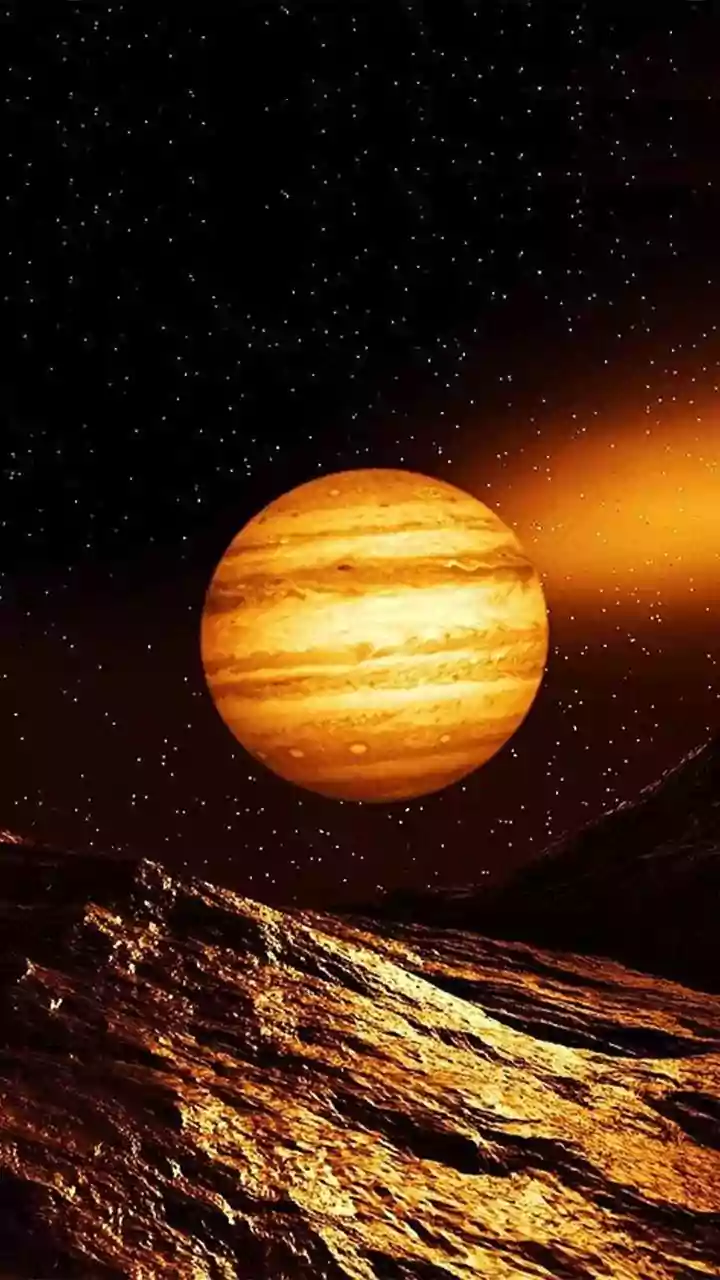
Voyager $1$'s primary mission to Jupiter and Saturn ended in $1980$, but its ultimate journey is timeless. Affixed to its side is the Golden Record, a gold_plated copper disk carrying sounds and images selected to portray the diversity of life and culture on Earth. It contains greetings in $55$ languages, music from different eras and cultures, and natural sounds of our planet. The record is a message in a bottle, cast into the cosmic ocean, designed to last for a billion years. As Voyager $1$ continues its silent passage, it is heading in the general direction of the star Gliese $445$, but it won't get close for another $40$,$000$ years. It is humanity's silent ambassador to the vastness of the Milky Way.