







The Promise of Icy Worlds
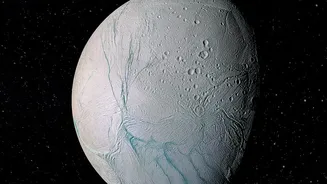
In our own solar system, some of the most compelling targets in the search for extraterrestrial life are not warm, Earth-like planets, but frigid, ice-covered moons. Jupiter's moon Europa and Saturn's moon Enceladus are chief among them. Both are believed
to harbor vast liquid water oceans concealed beneath kilometres-thick shells of ice. The key is that these oceans are in contact with a rocky core, which could provide heat and chemical nutrients through hydrothermal vents—the same kind of deep-sea structures that support vibrant ecosystems on Earth, completely cut off from sunlight. These conditions make the subsurface oceans of Europa and Enceladus prime candidates for habitable zones, where life, at least microbial life, could potentially arise and thrive. The challenge, however, is immense: how do you explore an ocean that is buried under a crust of ice that is not only thick, but also at cryogenic temperatures?
Earth's Frozen Laboratories
The answer starts here on Earth. To prepare for missions to these 'ocean worlds', scientists turn to the most similar environments they can find: the subglacial lakes of Antarctica. There are more than 400 known lakes buried beneath the Antarctic ice sheet, isolated from the atmosphere for millions of years. By studying these lakes, scientists can test the technologies and strategies needed for a future mission to Europa or Enceladus. Drilling expeditions into Antarctic lakes like Lake Whillans have successfully revealed microbial life that survives in total darkness by processing chemicals and minerals for energy. These terrestrial 'extremophiles' serve as a model for the kind of life that might exist on other worlds. These Earth-based projects are not just about finding life here; they are crucial dress rehearsals for developing contamination-proof drilling techniques and learning how to interpret the data that robotic explorers will one day send back.
A Toolkit for Cosmic Potholers
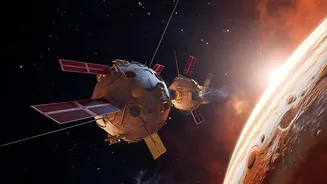
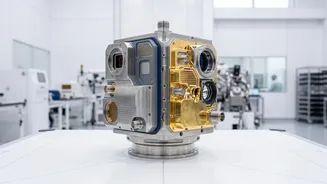
Peering beneath kilometres of alien ice requires a sophisticated toolkit. The first step is remote sensing. Instruments like ice-penetrating radar, which have been used to study Earth's glaciers for decades, are being adapted for space missions. NASA's Europa Clipper and ESA's JUICE missions both carry radar instruments designed to map the thickness of the ice shells and, hopefully, confirm the presence and depth of the subsurface oceans. For direct access, engineers are developing robotic probes called 'cryobots'. These are cylindrical, self-contained robots designed to melt their way through the ice. Concepts like NASA's PRIME (Probe using Radioisotopes for Icy Moons Exploration) would use a nuclear heat source to slowly descend, with a tether connecting it back to a lander on the surface for communication. Once it reaches the ocean, it could deploy smaller, independent swimming robots to explore further.
The Hunt for Biosignatures
Even with access to a subsurface ocean, finding life isn't as simple as spotting an alien fish. Astrobiologists search for 'biosignatures'—any substance, feature, or pattern that provides evidence of past or present life. These are not necessarily living organisms themselves but the tell-tale chemical fingerprints they leave behind. On Earth, this can include complex organic molecules, specific isotopic ratios, or an unusual mix of gases. A key strategy for Europa and Enceladus involves analyzing the plumes of water vapor that erupt from their surfaces, which offer a direct sample of the ocean below. Spacecraft flying through these plumes can use instruments like mass spectrometers to analyze the composition of the ice grains. Recent lab experiments have shown that modern instruments should be able to detect fragments of cellular material, like amino acids and fatty acids, even in tiny concentrations within these ejected ice grains, providing a powerful way to search for life without ever having to land.