



What Is the Cold Atom Lab?
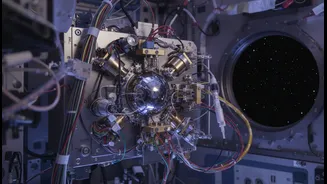
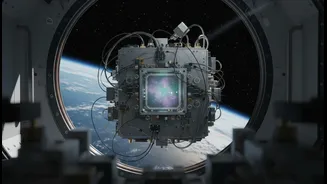
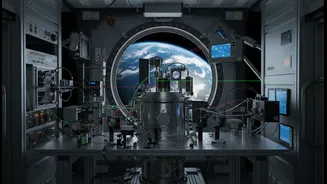
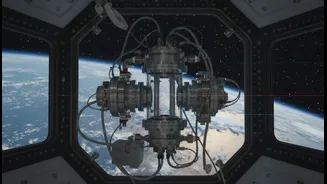
Think of the Cold Atom Lab (CAL) as a quantum research facility the size of a mini-fridge, operating in the unique microgravity environment of the ISS. Launched in 2018, its primary mission is to chill atoms to temperatures just a fraction of a degree
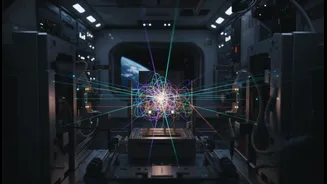
above absolute zero, or minus 273.15 degrees Celsius. At these extreme lows, atoms slow to a near standstill and can enter a fifth state of matter called a Bose-Einstein condensate (BEC). In a BEC, a cloud of individual atoms begins to behave like a single, massive quantum wave, making their bizarre quantum properties visible on a macroscopic scale. This allows scientists, who operate the lab remotely from Earth, to study fundamental quantum phenomena in ways impossible on the ground.
Why Study Cold Atoms in Space?
On Earth, gravity is a major problem for these experiments. Once a BEC is formed and released from its magnetic trap for study, gravity pulls the atoms down, limiting observation times to mere fractions of a second. In the continuous free-fall of orbit, these delicate quantum states can be observed for much longer periods—up to ten seconds or more. This extended observation time is crucial. It allows the matter waves to expand and evolve without disturbance, giving scientists an unprecedentedly clear window into the quantum world. The microgravity environment essentially provides a cheat code for physics, enabling experiments that push toward even colder temperatures and reveal new atomic interactions that are masked by gravity on Earth.
Details of the Major Quantum Upgrade
The latest hardware, which arrived at the station in April 2026 and was subsequently installed by astronauts, represents the fourth major upgrade to the facility. This isn't just a minor tweak; it's a significant overhaul of the lab's core components. The key improvements include a redesigned magnetic trap used to hold the atom clouds. This new trap is more versatile, allowing scientists to actively shape the quantum gases—squeezing them into lines or flattening them like pancakes—to investigate entirely new properties. The upgrade also features improved atom sources for creating the initial gas clouds of rubidium and potassium, as well as enhanced measurement capabilities, allowing for more precise science than ever before.
What New Science Is Now Possible?
This upgrade moves quantum research from observation to direct manipulation. Scientists are now entering an era described as "Quantum 2.0," where they can actively control and dictate the shape and interactions of large quantum states. This hands-on capability opens the door to probing fundamental physics that cannot be accurately modelled on even the most powerful computers. The enhanced lab will be used to test foundational principles of physics, potentially shedding light on mysterious forces like dark energy. Furthermore, these experiments are vital for developing future space-based quantum technologies, such as ultra-precise sensors for navigation and timing. These could one day allow astronauts to navigate on the Moon without relying on GPS or create highly detailed maps of Earth's gravitational field.