


A New Kind of Cosmic Engine
Until recently, the prime suspects for creating the universe’s most powerful neutrinos were supermassive black holes at the centres of active galaxies. But in June 2026, astronomers announced they had pinpointed the source of a high-energy neutrino detected
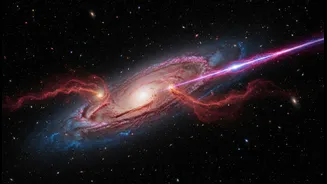
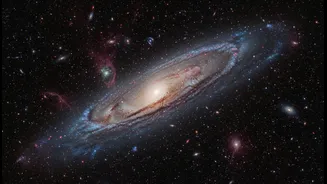
back in 2021 by the IceCube Observatory in Antarctica. The culprit was not a black hole, but a distant, dust-shrouded galaxy bursting with furious star formation. Scientists nicknamed it the “Shadow Blaster” because it’s almost invisible in normal light, hidden by its own dust, but glows brightly in submillimeter wavelengths. This discovery suggests that such “starburst” galaxies are a whole new class of cosmic particle accelerators, changing our map of the most violent places in the universe.
Solving the Cosmic-Ray Riddle
For over a century, scientists have been puzzled by the origin of cosmic rays—high-energy particles that constantly bombard Earth. Because they are charged, their paths get scrambled by galactic magnetic fields, making it impossible to trace them back to their source. However, neutrinos, which are neutral and barely interact with anything, are born from cosmic ray collisions and travel in a straight line. Finding a neutrino source is like finding a smoking gun for a cosmic ray factory. The Shadow Blaster galaxy is packed with gas and dust, creating a dense environment where cosmic rays can collide and efficiently produce neutrinos. This discovery provides strong evidence that dusty starburst galaxies are the long-sought “PeVatrons”—natural accelerators powerful enough to create the most energetic cosmic rays in our galaxy and beyond.
A New Window into Galaxy Evolution
The Shadow Blaster is not just any galaxy; it’s a window into the past, existing during an era known as “Cosmic Noon,” which occurred about 10-11 billion years ago when star formation across the universe was at its absolute peak. Because these ancient galaxies are so dusty, it’s incredibly difficult for traditional telescopes to see what’s happening inside them. Light gets blocked, but neutrinos fly right through. By detecting neutrinos from the Shadow Blaster, scientists are essentially gaining X-ray vision into the heart of a stellar nursery in the early universe. This allows them to study the extreme, high-energy processes that fueled the growth of the first massive galaxies, providing crucial data that was previously hidden from view and could rewrite our models of how galaxies evolve.
The Rise of Multi-Messenger Astronomy
This discovery is a landmark achievement for the exciting field of multi-messenger astronomy. The core idea is to combine different types of signals—light, gravitational waves, and particles like neutrinos—to get a complete, 360-degree view of a cosmic event. The most famous example was in 2017, when the merger of two neutron stars was seen in both gravitational waves and light across the spectrum. The Shadow Blaster event adds a new dimension. It started with a particle (a neutrino), which then guided telescopes to find its source in a specific type of light (submillimeter waves). This confirms that starburst galaxies are major players on the multi-messenger stage, offering another type of cosmic event that can be studied with a symphony of different signals.