
A New 10-Sided Mystery Wave
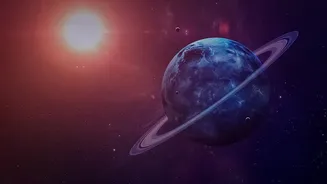
For decades, all eyes were on the famous six-sided jet stream at Saturn’s north pole. But very recently, a new geometric puzzle has emerged. As of early September 2026, images from the Hubble Space Telescope have revealed a massive, 10-sided pattern,
or decagon, forming around the planet's south pole. This is the first time such a large, regular-sided feature has been spotted in Saturn's southern hemisphere. Scientists using archival data found faint hints of the structure dating back to 2023, but the pattern has become much more distinct and appears to be strengthening. Unlike the long-lived northern hexagon, this decagon is a new development, giving researchers a rare chance to watch a giant atmospheric pattern being born.
The Famous Six-Sided Storm
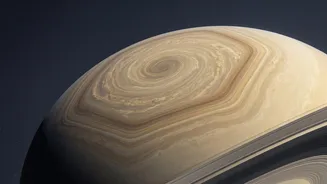
Before the decagon, there was the hexagon. Discovered during the Voyager mission in 1981, a massive, six-sided jet stream has been churning around Saturn's north pole for over 40 years. This isn't a storm in the traditional sense, but a persistent cloud pattern with sides longer than the diameter of Earth. The entire structure rotates at almost the same speed as the planet itself. Scientists have simulated this effect in labs, showing that when fluids are rotated at different speeds, they can form stable geometric shapes. On Saturn, a powerful jet stream, pinched by smaller vortices, is believed to warp into this incredibly stable and bizarre hexagonal shape.
Winds That Break the Sound Barrier
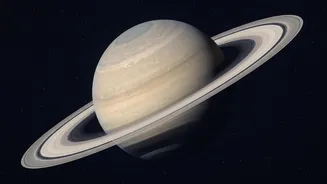
Saturn is one of the windiest places in our solar system. While a powerful hurricane on Earth might have winds of 250 kilometres per hour, the winds near Saturn's equator have been clocked at a staggering 1,800 kilometres per hour. These immense speeds are driven by heat rising from the planet's interior combined with its rapid rotation. The atmosphere, made mostly of hydrogen and helium, is whipped into parallel bands that race around the planet. These extreme winds are a key ingredient in shaping Saturn's other bizarre weather, including its giant, planet-encircling storms.
It Might Literally Rain Diamonds
This sounds like science fiction, but the science is plausible. Saturn's powerful lightning storms, some of the strongest in the solar system, can break down methane gas in the atmosphere. This process releases carbon, which falls as simple soot. As this soot descends deeper into the planet, the atmospheric pressure becomes immense, first crushing the soot into graphite and then, at depths of around 6,000 kilometres, compressing it into actual diamonds. These diamond 'hailstones' may continue to fall until they reach the planet’s scorching core, where they eventually melt into a liquid carbon sea. While this remains a scientific model and not a direct observation, it is based on the known conditions within the gas giant.
Planet-Sized 'Great White Spots'
Roughly once every 20 to 30 years, corresponding to a single Saturnian year, the planet's calm facade is broken by the eruption of a monstrous storm known as a 'Great White Spot'. These storms can grow to be as large as Earth and are powerful enough to eventually wrap themselves around the entire planet. The most recent one, which appeared in 2010, was the largest and most intense ever observed by the Cassini spacecraft, creating a disturbance that affected the atmosphere for over three years. Scientists believe these periodic outbursts are caused by a complex cycle where moisture suppresses convection for decades, allowing heat to build up until it erupts in a violent, planet-altering thunderstorm.