

The Grand Illusion We All Share
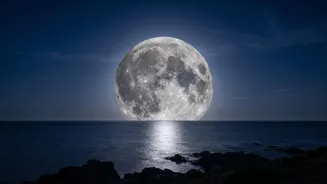
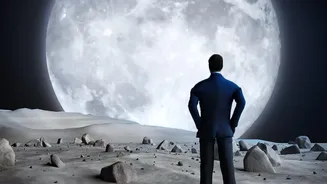
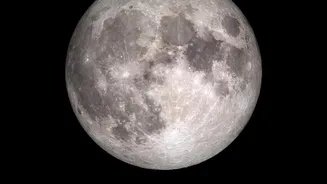
This powerful trick of the mind is famously known as the Moon illusion, though it applies to the sun and constellations, too. For centuries, people assumed the Earth’s atmosphere must be acting like a magnifying glass. But photographs and scientific measurements
prove this is false. In fact, the moon is slightly farther away when it’s on the horizon, not closer, meaning its image on our retina is actually a tiny bit smaller. So if the object itself isn't changing, and the atmosphere isn't magnifying it, what's going on? The entire spectacle is a fascinating quirk of neural processing—a feature, not a bug, in how our brains interpret the world.
Your Brain's Faulty Logic
The leading explanation for this phenomenon is called the 'Apparent Distance Hypothesis'. This theory proposes that our brain judges an object's size based on its perceived distance. It’s been discussed since antiquity and remains the most compelling reason for the illusion. Our brains are wired to believe that the sky directly overhead is much closer to us than the sky at the distant horizon. Think about it: clouds above your head seem nearer than clouds massing miles away at the edge of your view. This creates the perception of a 'flattened' sky dome. Our brain applies this same logic to the moon. When the moon is high up in the 'empty' sky with no reference points, our brain perceives it as being relatively close. But when it's on the horizon, it’s surrounded by familiar cues like trees, buildings, and hills, which our brain knows are far away.
The Ponzo Illusion on a Cosmic Scale
This scenario creates a powerful optical illusion, much like the famous Ponzo illusion. In that classic example, two identical lines are placed on a drawing of converging railway tracks. The line placed 'farther' down the tracks, where they appear to narrow, is perceived as being much larger than the 'closer' one. Your brain, seeing the perspective cues of the tracks, assumes the 'farther' line must be physically bigger to cast an image of the same size. The Moon illusion works on the same principle. The terrain on the horizon acts like the railway tracks, telling your brain, 'This object is very far away'. Since the moon's size on your retina remains the same, your brain makes a logical leap: for something to look that big from so far away, it must be enormous. Your visual processing system effectively 'enlarges' the moon to make sense of the scene, altering its perceived disk ratio.
Neural Processing and Size Constancy
This entire process is an example of a crucial neural mechanism called 'size constancy'. Size constancy is our brain's ability to perceive an object as being the same size regardless of how far away it is. It’s why a person walking away from you doesn't appear to shrink into a tiny doll; your brain automatically accounts for the increasing distance. Studies on the brain's visual cortex have shown that specific neurons integrate information about an object's retinal image size with cues about its distance to calculate its 'true' size. Our brains prioritize our knowledge of an object's real-world size and context over the raw data from our eyes. In the case of the horizon moon, the powerful distance cues from the landscape trigger this size constancy mechanism in an exaggerated way, forcing a perception that doesn’t match reality.