




Seeing is Time Traveling
The universe is so incomprehensibly vast that even its fastest traveler, light, takes an enormous amount of time to cross it. When you look at a star, you aren't seeing it as it is right now. You are seeing it as it was when its light began its journey
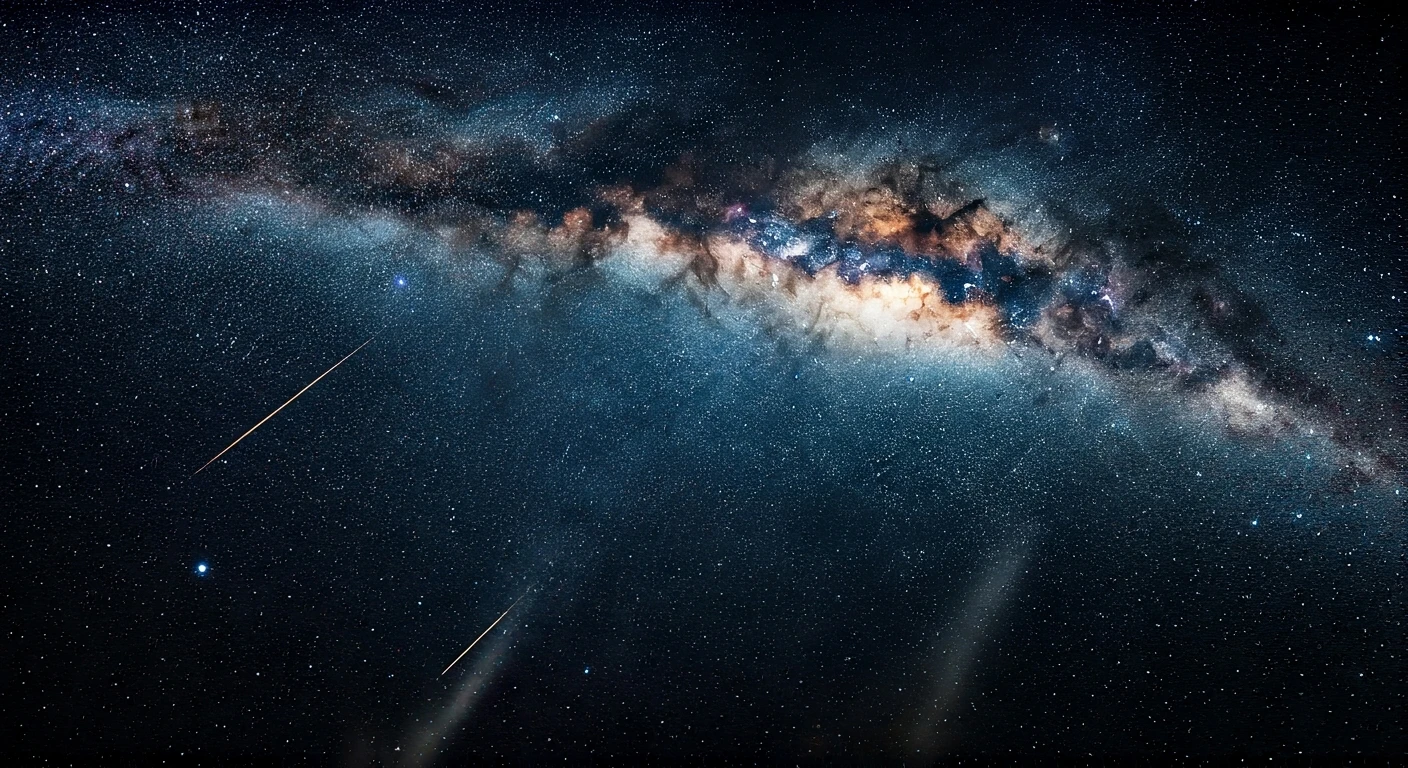
towards Earth. This delay turns every stargazer into an accidental time traveler. The light hitting your retina tonight could have left its star during the reign of the Mughal emperors, when Shakespeare was writing his plays, or before the first Europeans mapped the Indian coast. The night sky isn’t a static snapshot; it’s a collage of different historical moments, all arriving at once.
A Letter from the Past
To grasp this, we use the term 'light-year'. It sounds like a measure of time, but it’s actually a measure of distance: the distance light travels in one year. This is roughly 9.5 trillion kilometres. So, if a star is 100 light-years away, the light we see from it tonight left that star 100 years ago. It’s a message in a bottle, thrown into the cosmic ocean, that has only just washed up on our shore. For many of the stars twinkling above India, that message was sent centuries ago.
The North Star's Ancient Glow
Consider Polaris, the North Star. For centuries, it has been a reliable guide for travelers. But it’s also a remarkable time capsule. Polaris is approximately 433 light-years away. The faint, steady light you might spot from your balcony tonight began its journey around the year 1591. At that time in India, the Mughal Empire under Akbar was at its zenith, constructing architectural marvels and expanding its influence across the subcontinent. While courtiers in Fatehpur Sikri debated philosophy, the photons that would one day form the image of Polaris in your eye were just beginning their lonely, 400-year-plus voyage across the void. You are seeing the star not as it is today, but as it was during a completely different era of human history.
Orion: A Constellation of Ghosts
The famous constellation of Orion, the Hunter, is even more of a historical artefact. Its brightest stars are some of the most distant we can easily see. The brilliant, blue-white star Rigel, which forms Orion's left foot, is about 860 light-years away. Its light started traveling towards Earth around the 12th century, a time of the Chola dynasty in the south and the Ghurid dynasty's rise in the north. Meanwhile, the reddish giant Betelgeuse, at Orion’s shoulder, is about 550 light-years away. Its light is a dispatch from the 15th century, a time of great change across India and the world. Every time you look at Orion, you are seeing a celestial ghost whose light tells a story hundreds of years old.
A Universe of Yesterday
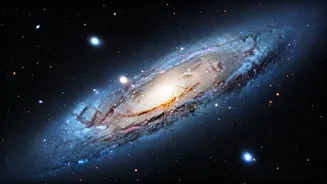
Not all stars are so distant. Sirius, the brightest star in our night sky and known as 'Vyadha' in Indian astronomy, is a relatively close neighbour at just 8.6 light-years away. Its light is only as old as a schoolchild. But further out, the Andromeda Galaxy—the most distant object visible to the naked eye—is 2.5 million light-years away. The light we see from it tonight left before modern humans even existed. This staggering range of distances means the night sky is not a single plane. It is a deep, three-dimensional history, with every point of light representing a different 'then'.