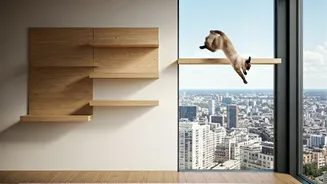









Thinking Vertically in a Horizontal World
In the wild, cats are masters of the three-dimensional world. They climb trees to survey their territory, escape threats, and ambush prey. This instinct doesn't disappear just because they live on the 15th floor. When we confine them to a flat floor plan,
we deny them a fundamental aspect of their nature. The solution? Create a 'cat superhighway'—a network of shelves, perches, and bridges mounted on the walls. This isn't about spoiling your pet; it's about providing essential environmental enrichment that allows them to express their natural behaviours, even in a compact urban apartment.
The Psychology of a High-Up Cat
Why are cats so obsessed with high places? It comes down to two core instincts: safety and status. From a high vantage point, a cat can see everything that happens in its territory—the approach of people, other pets, or the 'threat' of the vacuum cleaner—without being seen. This sense of security is profoundly calming for anxious felines. In multi-cat households, vertical space becomes even more critical. It acts as a pressure-release valve, allowing cats to establish social hierarchy without direct conflict. The cat with the highest perch often signals its dominance, reducing the need for terrestrial spats and territory marking.
More Than Just a Good View
The benefits of a vertical world extend beyond psychological well-being. Navigating a series of wall-mounted platforms provides a fantastic workout. It encourages jumping, stretching, and balancing, which helps maintain muscle tone and joint health, especially in less active indoor cats. A stimulated cat is also a less destructive cat. Boredom is the primary driver of unwanted behaviours like scratching furniture, excessive vocalisation, or aggression. By giving your cat an engaging environment to explore, you provide a positive outlet for their physical and mental energy, leading to a more harmonious home for everyone.
Planning Your Cat’s Ascent
Before you start drilling holes, take a moment to think like a cat. A good cat highway has a logical flow. Create routes that allow your cat to get up and down easily, with platforms spaced appropriately for their age and agility. A senior cat will need more closely spaced steps than a young, spry kitten. Consider placement: a perch in front of a securely-screened window offers 'cat TV,' while a route leading to a cosy, elevated bed creates the perfect private nap spot. Integrate the highway into your home's traffic flow, ensuring it doesn't obstruct doorways or create a hazard for human occupants.
DIY vs. Pre-Made Systems
You have two main options: build it yourself or buy a modular system. DIY offers ultimate customisation. You can use sturdy wooden planks, cover them with carpet or sisal rope for grip, and paint the brackets to match your decor. However, this requires a good understanding of structural integrity. Pre-made systems, available from various online retailers, are designed by professionals and have been tested for safety and durability. They often come in modular kits that you can expand over time. While they may be more expensive upfront, they offer peace of mind, especially if you're not confident in your own handiwork.
Safety is Not Optional
This is the most crucial step. A poorly installed shelf is more dangerous than no shelf at all. You must anchor every component securely into the wall studs, not just the plasterboard. In Indian homes with brick or concrete walls, this means using the correct wall plugs and screws. Always check the weight rating of your shelves and brackets, and remember to account for the dynamic force of a cat leaping onto them. Surfaces should be non-slip; bare, painted wood can be treacherous. Sand it lightly or add carpet squares, cork, or sisal for secure footing. Finally, ensure there are no long, vertical drops. Plan the descent route as carefully as the ascent.