





What Exactly Is New?
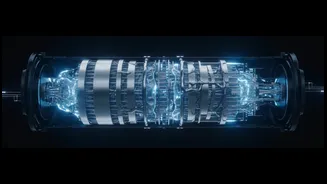
The latest breakthroughs in lithium-metal battery design are not about one single magic bullet, but a series of clever engineering solutions aimed at a notorious villain: the dendrite. Dendrites are tiny, sharp, tree-like crystal growths that form on the lithium-metal anode
during charging. These metallic branches can pierce the separator within the battery, causing short circuits, fires, and rapid battery death. Recent research has unveiled promising new strategies to tame them. One approach involves creating an “intelligent protective layer” by adding specific compounds, like thiophene, to the battery’s electrolyte. This layer can flexibly rearrange its structure to guide lithium ions, promoting smooth, even deposits instead of sharp dendrites. Another major development comes from using an ultrathin silver coating on solid electrolytes, which makes the battery's internal structure five times more resistant to the cracks that dendrites exploit.
The Science Simplified: Lithium-Metal vs. Lithium-Ion
So what makes this different from the lithium-ion battery in your pocket right now? It all comes down to the anode, one of the two electrodes that a battery uses to store and release energy. Today’s lithium-ion batteries use a graphite anode. Lithium-metal batteries, as the name suggests, use an anode made of pure, high-energy lithium metal. This simple switch has massive implications. A lithium-metal anode has a theoretical capacity nearly ten times greater than graphite. This is what gives it the potential for such a huge leap in energy density—the amount of energy stored in a given space or weight. While most lithium-metal batteries found in devices like watches are non-rechargeable, the global race is on to perfect a rechargeable version for mass-market applications.
What Matters: The Real-World Impact
If these new designs can be successfully commercialized, the impact would be transformative. For electric vehicles (EVs), it is the holy grail. A stable, high-density lithium-metal battery could extend driving ranges to well over 800 or even 1,200 kilometres on a single charge, effectively eliminating range anxiety. Some new designs also promise dramatically faster charging, potentially getting you back on the road in as little as 12 minutes. Beyond cars, the benefits would ripple through all of our technology. Drones could fly longer missions, a crucial advantage for delivery, agriculture, and defense. Laptops and smartphones could become thinner and lighter while offering multi-day battery life. It represents a fundamental step-change in portable power that could enable entirely new categories of devices.
What Remains Unclear: The Path to Your Car
Despite the exciting lab results, a long road remains before a lithium-metal battery is powering your family car. The primary challenge is scalability and cost. Techniques that work perfectly in a pristine lab environment, like applying a flawless 3-nanometer-thick silver coating, are incredibly difficult and expensive to replicate on a massive industrial scale. Researchers still need to validate these new designs over thousands of charge-discharge cycles under real-world conditions, including extreme heat and cold, to ensure they are both durable and safe. While some companies are now moving into pilot production and commercial testing for applications like drones, major automotive players suggest that widespread availability in passenger EVs is still years away, with forecasts ranging from 2028 to the early 2030s.