


A Signal From Across the Stars
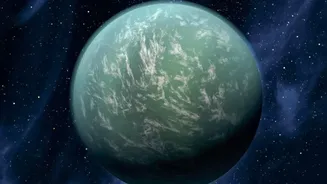
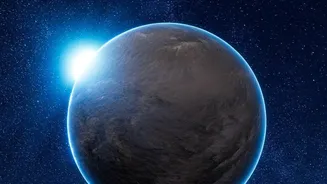
Scientists announced that the powerful infrared eyes of the Webb telescope have analysed the skies of several Earth-sized planets orbiting distant stars. The findings confirm what was once theoretical: the presence of water molecules in the atmospheres
of rocky worlds outside our solar system. One of the systems under investigation, Wolf 1069, located just 31 light-years away, has been a particular focus. Its planet, Wolf 1069 b, is an Earth-mass world situated in its star's 'habitable zone' — the orbital region where conditions could allow for liquid water. While previous observations hinted at the possibility, Webb’s new data provides the most definitive evidence to date, marking a pivotal moment in astronomy.
How Webb Sees an Alien Atmosphere
Detecting the chemical makeup of a planet light-years away is a monumental feat of engineering and physics. Webb achieves this using a technique called transit spectroscopy. As an exoplanet passes in front of its host star from our perspective, a tiny fraction of the starlight filters through the planet's atmosphere. Different gases in that atmosphere absorb specific wavelengths, or colours, of light. Webb’s highly sensitive spectrographs can detect these minuscule dips in the starlight, creating a 'spectrum' that acts like a chemical fingerprint. By reading this fingerprint, astronomers can identify the molecules present, including the tell-tale signature of water vapour.
Not Earth 2.0, But a Crucial First Step
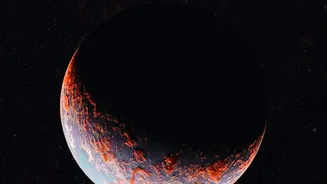
While incredibly exciting, finding water vapour doesn't automatically mean a planet hosts oceans or life. Many of these rocky worlds are very different from our own. Wolf 1069 b, for example, is 'tidally locked,' meaning one side perpetually faces its star in constant daylight, while the other is shrouded in eternal night. This can create extreme temperatures. However, climate models suggest that if the planet has a substantial atmosphere, heat could be distributed, potentially creating stable, temperate conditions where liquid water could exist. The discovery is less about finding a new Earth and more about proving we have the tools to identify the essential ingredients for life elsewhere.
The Search for a Cocktail of Life
Water is a vital prerequisite for life as we know it, but it’s only one part of the puzzle. Scientists are now focused on searching for 'biosignatures' — a combination of gases that would strongly suggest the presence of biological processes. For example, finding an atmosphere with water, methane, and oxygen all at once would be a game-changer. On Earth, these gases coexist because life is constantly replenishing them. Without a biological source, they would react with each other and disappear over geological time. Webb’s ability to detect water is the first step in a much larger investigation to find this specific cocktail of gases that could point to an inhabited world.
A Global Quest With Local Pride
This breakthrough is a testament to a global collaboration in science and technology. The James Webb Space Telescope is an international partnership, and its discoveries belong to all of humanity. For India, a nation with a proud and ambitious space program, these findings are particularly resonant. As the Indian Space Research Organisation (ISRO) continues to push the boundaries with missions to Mars (Mangalyaan) and its planned Venus orbiter mission (Shukrayaan-1), the work of Webb provides both inspiration and a valuable scientific roadmap. These discoveries from across the cosmos help inform India's own search for answers about our place in the universe, highlighting the nation's growing role in the international scientific community.