

What Exactly Is 'Mechazilla'?
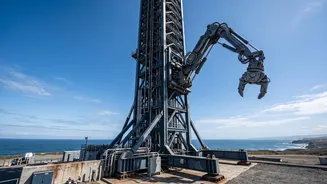
Mechazilla is the nickname given to SpaceX's Starship launch and integration tower. Standing nearly 400 feet tall, it's more than just a launchpad; it’s an active participant in the rocket's recovery. Its most distinctive features are two colossal robotic
arms, often called 'chopsticks', that can move up, down, and pivot. These arms are powered by high-pressure hydraulic systems and are designed for the dual purpose of stacking the Starship spacecraft on top of the Super Heavy booster before launch and, most ambitiously, catching the booster as it returns to Earth. The system uses a combination of high-resolution cameras, LiDAR, and advanced control algorithms to track the descending booster with centimetre-level precision, allowing the arms to position themselves for a successful catch.
The Catch Sequence Explained
After the Super Heavy booster separates from the Starship upper stage, it performs a boostback burn to reverse its course and head back toward the launch site. As it descends through the atmosphere, four large, waffle-patterned grid fins at the top of the booster steer it toward the tower. In the final moments of its descent, the booster ignites a subset of its 33 Raptor engines to dramatically slow down, eventually coming to a near-hover next to the tower. This is when Mechazilla's arms, which have been waiting in a wide-open position, swing in and close around the booster, clamping onto reinforced hardpoints near the grid fins. Once secured, the tower can lower the booster directly onto the launch mount, ready to be prepared for its next flight.
Why Not Just Use Landing Legs?
SpaceX perfected propulsive landings with its Falcon 9 rocket, which uses deployable landing legs to touch down on droneships or landing pads. The decision to forgo legs on the much larger Super Heavy booster is a calculated trade-off. Landing legs, especially ones strong enough to support the massive Super Heavy, add significant weight. By eliminating them, SpaceX saves mass that can instead be used for more propellant or a heavier payload, improving launch efficiency. This 'mass to orbit' is the ultimate currency of rocketry. The tower catch strategy effectively outsources the landing hardware to the ground, where weight is not a penalty. This integrated system treats the launch site itself as part of the recovery vehicle.
The Goal: Rapid and Complete Reusability
The primary driver for the Mechazilla concept is enabling airline-like operations for spaceflight. Catching the booster and placing it directly back on the launch mount eliminates the need for recovery ships and the complex logistics of transporting a landed rocket back to the pad. SpaceX's goal is to inspect, refuel, and re-fly a booster in under an hour, a cadence that would dramatically slash the cost of accessing orbit. This rapid turnaround is essential for the company's long-term ambitions, such as building a self-sustaining city on Mars, which would require launching a massive fleet of Starships in a short window every 26 months. It also underpins the business case for launching next-generation Starlink satellites and enabling super-fast point-to-point travel on Earth.
An Immensely Risky Maneuver
The engineering challenge is monumental. The system must account for atmospheric conditions, engine performance, and precise timing, all while handling a 250-ton object descending at high speed. A small error in the booster's trajectory or a malfunction in the tower's hydraulic arms could be catastrophic, resulting in the loss of both the booster and the expensive launch tower infrastructure. While SpaceX has successfully caught Super Heavy boosters multiple times since the first attempt in October 2024, the risk remains with every attempt. The next, even harder step is catching the Starship upper stage, which returns from orbital velocity and endures far greater reentry energies.