



The Sun’s Unseen Threat
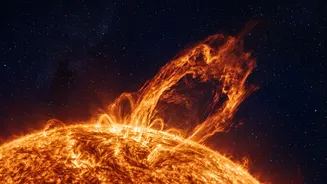
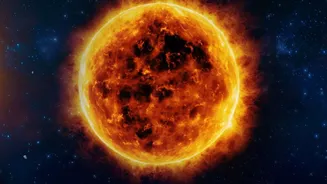
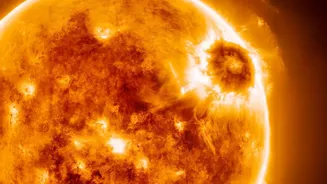
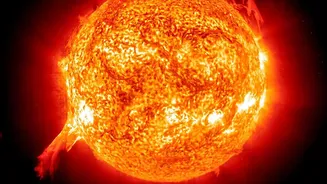
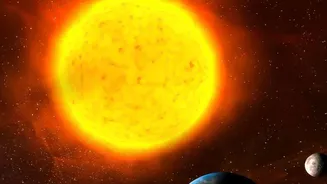
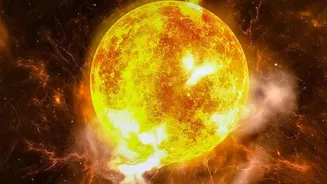
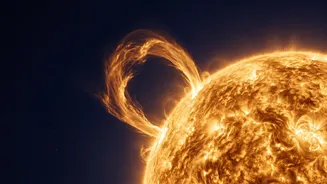
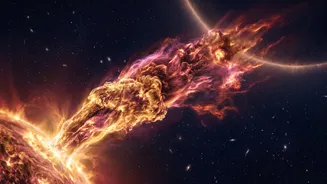
The Sun, our life-giving star, has a volatile side. It constantly sends out a stream of charged particles known as the solar wind. Occasionally, it unleashes enormous explosions of energy, called solar flares, or hurls massive clouds of plasma, known as coronal
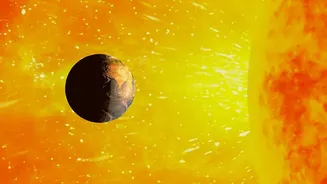
mass ejections (CMEs), into space. When a powerful CME is aimed at Earth, it can interact with our planet's magnetic field, triggering a geomagnetic storm. While these storms produce beautiful auroras, they also pose a significant threat to our modern way of life, which is deeply reliant on sensitive electronics.
Impact on a Digital India
The consequences of a severe solar storm could be devastating for a digitally-driven nation like India. These storms can induce powerful electrical currents in the ground that could overload and damage power grid transformers, potentially causing widespread and long-lasting blackouts. Our reliance on satellites for everything from UPI payments and stock market operations to GPS navigation for ride-sharing apps and food delivery would be under threat. Solar storms can damage satellite electronics, interfere with their signals, and even alter their orbits, risking collisions. For aviation, it means disrupted radio communications, especially on long-haul routes. In essence, the backbone of modern Indian life could be severely compromised.
The Challenge of Prediction
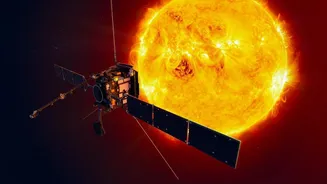
The problem isn't that we're completely blind to space weather. Scientists use a fleet of satellites and telescopes to monitor the Sun for warning signs like sunspots and solar eruptions. However, forecasting the impact of these events is incredibly difficult. While we can see a solar flare as it happens, the radiation travels at the speed of light, giving us no time to react. CMEs take one to four days to reach us, but predicting which ones will hit Earth and how powerful their impact will be is a major challenge. Current methods often provide accurate warnings only minutes before a storm hits, which is not enough time to protect critical infrastructure.
Enter Artificial Intelligence
This is where artificial intelligence comes in. The sheer volume of data coming from solar observation satellites is immense—far too much for humans to analyse effectively in real time. AI, specifically a technique called deep learning, can be trained to sift through this data and recognise subtle patterns that precede a major event. By analysing countless past examples of solar wind measurements and the resulting geomagnetic disturbances on Earth, an AI model can learn to identify the complex relationships that are invisible to human analysts. The goal is to create a system that can issue fast, reliable warnings, acting like a planetary tornado siren for space weather.
NASA's AI-Powered Forecaster
NASA is at the forefront of this effort with a new AI model called DAGGER (Deep Learning Geomagnetic Perturbation). Developed through a public-private partnership, DAGGER analyses real-time data from solar wind-monitoring spacecraft to predict where and when a geomagnetic disturbance will occur anywhere on Earth. The results are promising. In tests against past solar storms from 2011 and 2015, DAGGER was able to accurately forecast the storm's impact with a 30-minute lead time. While half an hour might not sound like much, it's a significant improvement and could be enough time for power companies to protect their grids and satellite operators to place their spacecraft into a safe mode.
The Road Ahead
So, can AI reliably spot the early signals of solar storms? The answer is a promising 'yes', but the technology is still evolving. The DAGGER model is a massive step forward, moving from localised predictions to a global, fast, and accurate system. One of the lead authors on the paper, Vishal Upendran from India's Inter-University Centre for Astronomy and Astrophysics, noted that this AI makes rapid global predictions possible. The model's code is open source, allowing companies and grid operators to adapt it for their specific needs. It’s not a final solution, but a powerful new tool in our arsenal to defend against one of nature's most powerful phenomena.