

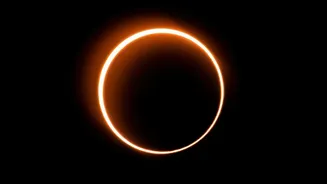
A Shadow Over the North Atlantic
This summer's main astronomical event will see the Moon's shadow trace a path across the Arctic, Greenland, Iceland, and into northern Spain and a small part of Portugal. While many in Europe, North Africa, and even parts of North America will witness
a partial eclipse, only those within this relatively narrow band, known as the path of totality, will experience the full, awe-inspiring phenomenon. For a little over two minutes at the point of maximum eclipse, day will turn to an eerie twilight, temperatures will drop, and the Sun will vanish behind the lunar disk. This event marks the first total solar eclipse visible from mainland Europe since 1999 and has become one of the most anticipated astronomical events of the decade.
The Mystery of the Sun's Crown
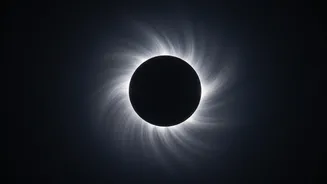
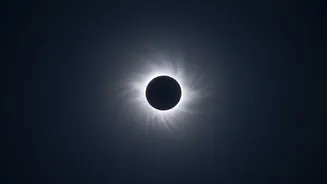
When the brilliant face of the Sun is completely blocked, its magnificent outer atmosphere, the corona, becomes visible. Normally hidden by the Sun's own glare, the corona is a wispy, pearly-white crown of plasma that is, paradoxically, hundreds of times hotter than the surface below. Total eclipses are the only time, without specialized equipment, that scientists can study this enigmatic region from Earth. Understanding the corona is key to solving major solar puzzles, like the mechanics of the solar wind — a stream of charged particles that flows from the Sun and can impact our satellites and power grids. Every eclipse provides different data because the Sun is constantly changing, with the corona's shape and complexity varying with the solar cycle.
NASA's High-Altitude Chase
To seize this rare opportunity, NASA is deploying some of its most advanced observational tools. A team will fly one of NASA's WB-57 high-altitude research aircraft along the eclipse path. Soaring at 50,000 feet, the jet will chase the Moon's shadow, extending its view of totality to nearly three minutes. A suite of high-resolution cameras in the plane's nose cone will capture images of the corona in multiple wavelengths of light, helping scientists investigate its structure, its extreme temperature, and the origins of solar prominences. Additionally, the NASA-supported Nationwide Eclipse Ballooning Project will see student-led teams launch dozens of scientific balloons from Iceland and Spain. These balloons will gather data on how the temporary loss of sunlight affects Earth's own atmosphere, particularly the boundary layer closest to the ground.
Testing Theories from the Edge
The headline's mention of a "narrow eclipse path" points to a more subtle but critical scientific goal. The appearance of the eclipse, particularly the sun's corona and phenomena like the "diamond ring effect," can look different depending on where you are within the path of totality. Observations from the center of the path provide one type of data, while those near the edges provide another. This eclipse is a perfect chance for researchers to test and refine computer models that predict what the corona will look like. By stationing observers and instruments at various points across the path, scientists can compare the reality of the eclipse to their forecasts. Improving these models is not just an academic exercise; it's essential for better forecasting of space weather, which can have real-world consequences on our technology-dependent society.
A Spectacle with a Purpose
For those in northern Spain, the eclipse will offer an extra-special view: a "sunset eclipse," where the totally eclipsed Sun will hang low over the horizon, potentially creating breathtaking photographic opportunities. The timing also coincides with the peak of the annual Perseid meteor shower, offering a double-feature for sky-gazers. But beyond the sheer beauty, the 2026 eclipse serves as a powerful reminder of how these ancient celestial alignments continue to drive modern science. It's a global event that brings together professional researchers, student scientists, and the public in a shared moment of wonder and discovery, proving that there is still much to learn from looking up at the sky.