







What is the SKA?
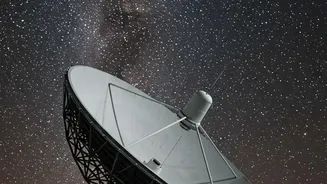
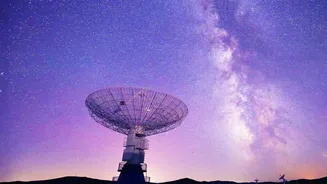
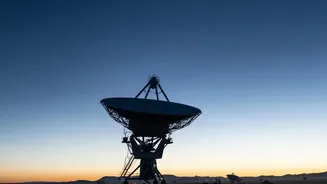
The Square Kilometre Array (SKA) is a monumental global science project designed to build the world's largest and most sensitive radio telescope. It's not a single giant structure, but a vast network of thousands of antennas spread across two remote desert
locations: South Africa and Australia. The South African site, SKA-Mid, will feature 197 large dish antennas, while the Australian site, SKA-Low, will consist of 131,072 smaller, Christmas-tree-like antennas. This dual-continent approach allows the observatory to cover a wide range of radio frequencies. The project's name comes from its ultimate ambition to have a total signal collecting area of one square kilometre. Construction officially began in late 2022, with a global consortium of countries, including India, collaborating on this multi-decade effort to revolutionise our understanding of the cosmos.
An Ear Turned to the Cosmic Dawn
One of the SKA's primary missions is to peer back in time to an era known as the Cosmic Dawn, which occurred a few hundred million years after the Big Bang. Before this period, the universe was a dark, starless expanse filled with neutral hydrogen gas. The SKA is designed to detect the faint radio signals emitted by this primordial hydrogen at a specific wavelength of 21 centimetres. As the universe expanded, this signal has been stretched, or 'redshifted', to much longer wavelengths, which the SKA-Low telescope in Australia is specifically engineered to capture. By mapping these incredibly weak signals, which are thousands of times fainter than the background noise from our own galaxy, astronomers hope to witness the birth of the very first stars and galaxies, effectively watching the universe switch on for the first time.
India's Stake in the Cosmos
India is a key player and a full member of the SKA Observatory. The nation's involvement is coordinated by the National Centre for Radio Astrophysics (NCRA) in Pune, which leverages the expertise gained from operating the Giant Metrewave Radio Telescope (GMRT), a world-class SKA pathfinder facility. Indian scientists and engineers have been instrumental since the project's early days, notably leading the international team that designed the Telescope Manager, the crucial 'nervous system' that will control the entire observatory. With a financial commitment of ₹1250 crore, India is contributing to vital construction phase activities, including software development and hardware for the SKA-Low telescope. This participation ensures that Indian researchers will have significant access to the telescope's observation time, placing them at the forefront of cosmic discovery.
Unlocking Deeper Cosmic Mysteries
Beyond the Cosmic Dawn, the SKA's unprecedented sensitivity will tackle some of the biggest questions in modern physics. It will investigate the nature of dark matter and dark energy, mysterious components that are believed to make up about 95% of the universe. Scientists will also use the SKA to test Einstein's theories of general relativity in extreme gravitational environments by timing pulsars, which are incredibly dense, spinning neutron stars. The telescope will also hunt for the origins of enigmatic fast radio bursts, probe cosmic magnetism, and even search for complex organic molecules and potential biosignatures in space, aiding the search for life beyond Earth. The sheer volume of data the SKA will generate—petabits per second—presents its own colossal challenge, requiring some of the world's fastest supercomputers and driving innovation in big data processing and AI.