
More Than Meets the Eye
Our eyes are incredible, but they are also limited. We only see a tiny fraction of the light that exists in the universe, a sliver called the 'visible spectrum'. It’s no coincidence that this is the type of light our own sun pumps out the most. But just
as a radio can tune into many different stations, the universe is broadcasting on countless other 'channels' or wavelengths. These range from low-energy radio waves and microwaves, through the infrared light we associate with heat, past our familiar visible colours, and up to high-energy ultraviolet, X-rays, and gamma rays. An object's temperature and energy determine which kind of light it primarily emits. To truly understand a galaxy, astronomers can't just look; they have to listen in on every single one of these frequencies.
The Familiar Visible Light View
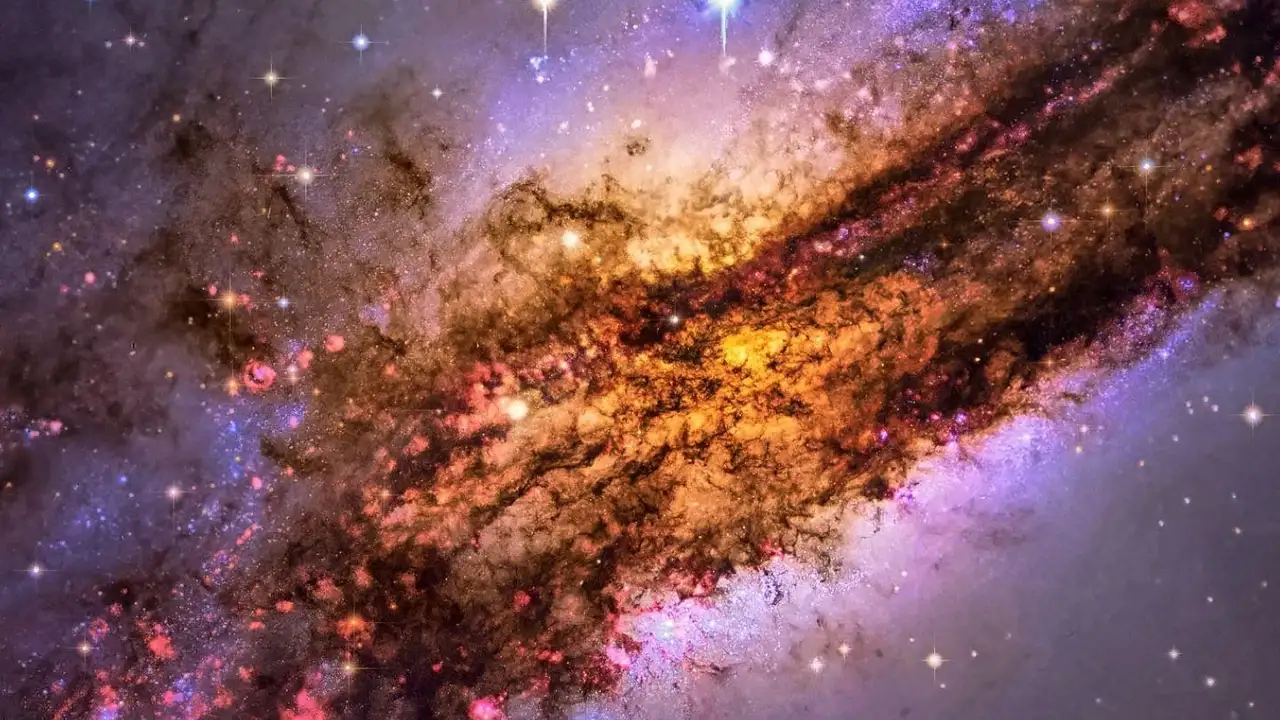
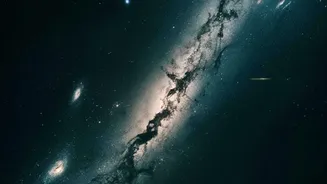
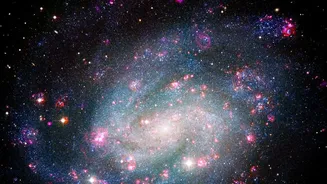
The images of galaxies we know and love are typically taken in visible light. Telescopes like the Hubble Space Telescope capture what our eyes would see if they were powerful enough. In this view, we see the combined glow of billions of stars. We also see dark, dramatic lanes cutting through the starlight. For a long time, astronomers thought these were empty voids. We now know they are vast clouds of interstellar dust, which act like a cosmic fog, blocking the visible light from stars behind them. This view is beautiful, but the dust hides a huge amount of activity. It gives us a biased picture, showing us the stars but concealing the raw materials and the most violent events.
Peering Through the Dust with Infrared
This is where infrared light changes the game. Longer wavelengths of infrared can pass straight through the dense dust clouds that block visible light. When astronomers switch their telescopes to infrared detectors, like those on the James Webb Space Telescope, those dark dust lanes suddenly glow. We are no longer seeing them as silhouettes, but seeing the faint heat of the dust itself and, crucially, what’s inside. This technique reveals stellar nurseries—cosy cocoons where thousands of new stars are being born, hidden from optical view. It also picks up the glow of cooler, older stars that are too faint to feature prominently in visible light images. The 'empty' parts of the galaxy are suddenly revealed to be teeming with action.
A Universe of Violence: X-Rays and Gamma Rays
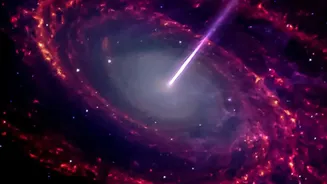
If infrared reveals the galaxy’s hidden nurseries, high-energy light like X-rays and gamma rays reveals its most violent and extreme phenomena. To see in X-rays, observatories must be in space, as Earth's atmosphere thankfully blocks this radiation. When telescopes like NASA's Chandra X-ray Observatory look at a seemingly peaceful galaxy, they see a completely different reality. This light is produced by matter heated to millions of degrees, often by intense gravitational or magnetic forces. We suddenly see supermassive black holes at the galactic core devouring matter, and giant jets of high-energy particles being blasted thousands of light-years into space. We can also spot individual points of light that are neutron stars or smaller black holes caught in binary star systems, siphoning material from their companions. In X-ray light, a serene spiral galaxy can look like a site of constant, raging explosions.
Mapping the Fuel with Radio Waves
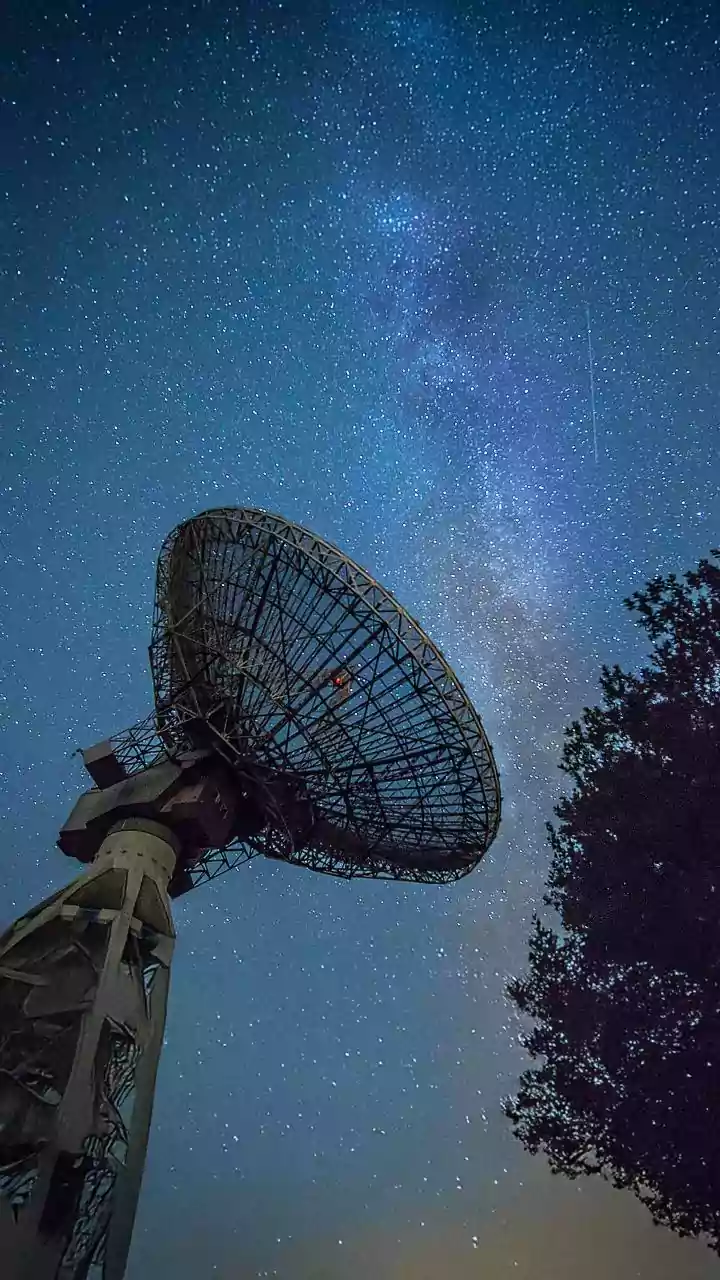
On the other end of the spectrum, long-wavelength radio waves show us something else entirely: the raw fuel for future stars. Radio telescopes, which often look like giant dishes, map out vast clouds of cold hydrogen gas. This is the material from which stars are made, and radio observations can show it extending far beyond the visible boundaries of the galaxy. Radio waves also allow astronomers to see the full extent of the giant jets fired from supermassive black holes. While X-rays show the hot, energetic base of the jets, radio waves trace their path as they cool and expand into intergalactic space. This provides crucial evidence of how a galaxy's core can influence its outermost regions.
The Full Picture: A Composite Masterpiece
No single wavelength tells the whole story. The true power of modern astronomy comes from combining these different views. Scientists often create composite images, assigning visible colours (like red, green, and blue) to data from invisible wavelengths (like infrared, X-ray, and radio). A great example is the galaxy Centaurus A. In visible light, it looks like an elliptical galaxy sliced in half by a thick dust lane. But when you add in other wavelengths, the full picture emerges. Infrared reveals the structure of a warped disc of gas, evidence of a past galactic merger. X-ray and radio views unveil colossal jets erupting from the supermassive black hole at its centre. Only by combining all this information can astronomers piece together the history and behaviour of this complex system.