







A Lucky Break Reveals Yellow Crystals
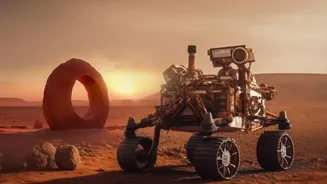
In May 2024, while traversing a channel known as Gediz Vallis, the 899-kilogram Curiosity rover rolled over a seemingly ordinary rock. The rock cracked under the rover's weight, revealing a pale yellow, crystalline interior. Analysis by the rover’s instruments
confirmed this was something never before identified on Mars: elemental sulfur, or sulfur in its pure form. Scientists were stunned. While sulfur-based compounds are common on the Red Planet, finding it in this pure state was a first, sparking an immediate investigation into how it got there. To make things even more intriguing, this wasn't an isolated find; the rover had stumbled upon an entire field of similar-looking rocks.
Not All Sulfur Is Created Equal
It's important to understand why this discovery was so shocking. For years, Curiosity and other missions have found sulfates all over Mars. Sulfates are salts containing sulfur and oxygen, typically left behind when water evaporates. These minerals are crucial because they act as signposts, telling the story of where water once flowed or pooled on the planet billions of years ago. Elemental sulfur, however, is different. It's pure sulfur atoms unbonded to other elements. On Earth, large deposits of elemental sulfur are often linked to specific, high-energy events like volcanic activity or hydrothermal vents bubbling with hot water. But the area around Gediz Vallis showed no signs of the extreme heat required for such processes.
A Geological 'Oasis in the Desert'
The presence of an entire field of pure sulfur rocks, scattered over an area of about 2,100 square meters, presented a major puzzle. As Curiosity's project scientist, Ashwin Vasavada, put it, finding the sulfur field was 'like finding an oasis in the desert'. He explained, 'It shouldn't be there, so now we have to explain it'. The rocks themselves were also noted to be quite fragile, breaking easily under only a portion of the rover's weight. This fragility suggests they likely formed in the very spot they were found, as they probably would not have survived being transported by ancient floods or landslides. This left scientists with a baffling question: how could so much pure sulfur form in this location without any obvious heat source?
New Theories Explain the Mystery
By 2026, follow-up studies began offering potential solutions. One leading theory, published in the journal 'Science', proposes a cold-formation process that happened roughly three billion years ago. Researchers suggest that sulfur-bearing gases, likely released from ancient volcanic activity elsewhere on the planet, became trapped beneath the surface, possibly within water ice. Much later, erosion carved out the Gediz Vallis channel, releasing the pressure on these trapped gases. As the gases escaped and interacted with other elements in a low-temperature environment, they could have reacted to form the fields of pure elemental sulfur that Curiosity discovered. Another study showed that acidic water mixed with certain chlorine compounds, also thought to exist on ancient Mars, could produce pure sulfur crystals at room temperature.
What This Means for the Story of Mars
While this discovery is not evidence of life, it adds a fascinating new layer to our understanding of the Red Planet's ancient environment. It shows that Mars had more complex and diverse chemical processes than previously thought, capable of creating pure elements without the high temperatures we are used to seeing on Earth. The findings provide a clearer picture of how gases moved underground, the details of ancient water chemistry, and how certain geological features can survive almost unchanged for billions of years. It confirms that key ingredients for life, like sulfur, were present in various forms. Every unexpected find like this one helps scientists build a more complete and accurate history of our planetary neighbor.