


The Universe's Biggest Mystery
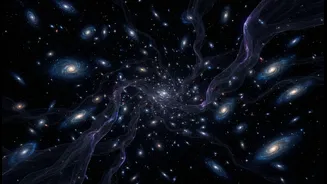
Imagine everything you can see—stars, planets, galaxies, and even yourself. All of that makes up less than 5% of the known universe. A staggering 27% is composed of dark matter, a substance we cannot see or touch. So, how do we know it's there? Gravity.
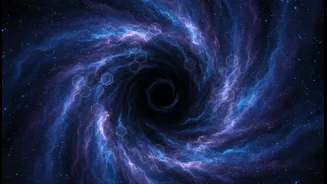
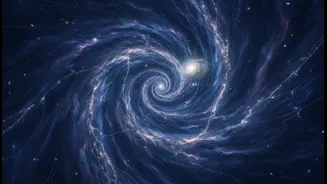
Astronomers observed that galaxies were spinning so fast they should have flown apart. The only way they could hold together is if they were embedded in a massive, invisible halo of matter, providing the extra gravitational glue. This invisible mass is dark matter. The problem is, it doesn't interact with light or any other forces in the Standard Model of particle physics, which is our current rulebook for the subatomic world. This means whatever dark matter is, it must be something entirely new.
Thinking Outside Our Dimensions
When your known physics fails, you need to think outside the box—or in this case, outside our dimensions. We experience the world in three spatial dimensions (length, width, and height) and one of time. But for over a century, physicists have toyed with the idea that more dimensions could exist. Early theories suggested an extra dimension might be curled up so tightly, a trillionth of a trillionth the size of an atom, that we would never perceive it. Think of a tightrope walker: from far away, the rope looks like a one-dimensional line. Only by getting closer do you see its true, three-dimensional shape. These extra-dimensional theories, like string theory, predict that new particles could exist if they can vibrate in these hidden directions.
A Warped Reality
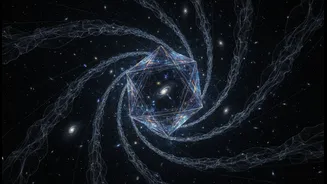
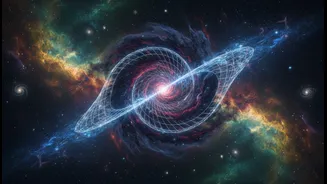
One of the most influential extra-dimensional ideas is the "Warped Extra Dimension" (WED) model, first proposed in 1999. This theory suggests our entire four-dimensional universe is just a membrane, or "brane," floating within a larger, five-dimensional space. But this isn't just an empty space; it's warped. Gravity, unlike other forces, isn't stuck to our brane. It can leak into and out of this fifth dimension. This elegant idea helps explain one of physics' other great puzzles: why gravity is so much weaker than other forces like electromagnetism. In this model, gravity feels weak to us because its influence is spread out across the extra dimension. All the other particles and forces that make up our world, however, are confined to our brane, unable to escape.
Where Dark Matter Fits In
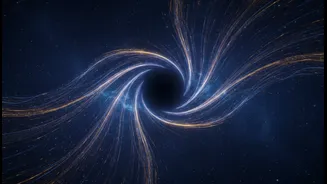
This is where it all comes together. If our universe is a brane in a higher-dimensional space, what if dark matter is simply matter that lives in that extra space? A recent extension of the WED model proposes that certain types of particles, known as fermions, could be pushed off our brane and into the fifth dimension through theoretical "portals". Once there, they would be invisible to us because they can no longer interact with our light or matter. However, they would still have mass and would still exert gravity. We would feel their gravitational pull across the dimensional boundary, which would perfectly explain the invisible halos holding galaxies together. More recent theories from July 2026 even suggest the unique geometry of this hidden dimension creates a natural "resonance," which would have made dark matter interact strongly in the early universe but makes it almost undetectable today.
The Hunt for a Hidden World
This might sound like science fiction, but these theories offer tangible predictions that can be tested. For instance, if dark matter exists in another dimension, its gravitational influence could create ripples in spacetime—gravitational waves—with a unique signature that our next generation of detectors might be able to pick up. Another place to look is at particle colliders like the Large Hadron Collider. When particles are smashed together at incredible speeds, physicists look at the energy and momentum before and after. If some energy appears to go missing, it might be a clue that a new particle, like a graviton, has been produced and immediately escaped into a hidden dimension. Finding such evidence would be one of the most profound discoveries in the history of science.