



A Cat Video Watched Around the Solar System
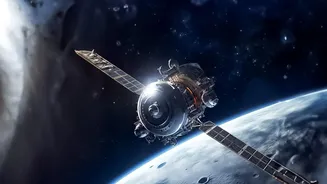
In a delightful intersection of internet culture and cutting-edge science, the first ultra-high-definition video beamed from deep space starred a cat named Taters. The 15-second clip of the orange tabby chasing a laser was transmitted from NASA's Psyche
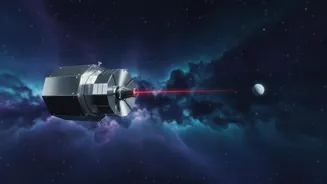
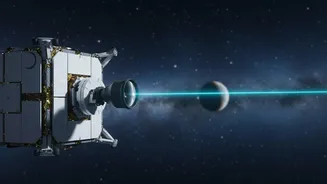
spacecraft when it was nearly 19 million miles from Earth — about 80 times the distance to the Moon. The historic transmission was part of the Deep Space Optical Communications (DSOC) experiment, a technology demonstration designed to prove that laser communications can handle the massive data loads of future interplanetary missions. The video was sent at a maximum rate of 267 megabits per second (Mbps), taking just 101 seconds to reach the Hale Telescope at Caltech's Palomar Observatory in California. This successful test served as a charming, yet profound, proof of concept.
How Laser Communication Transforms the Game
For decades, deep space missions have relied on radio frequency (RF) systems to send and receive data. While reliable, RF technology is nearing its bandwidth limit, much like a rural road can't handle city traffic. Laser, or optical, communication is the equivalent of upgrading to a multi-lane superhighway. Lasers use near-infrared light, which has a much higher frequency than radio waves. This allows them to pack significantly more data into the transmission. The result is data rates 10 to 100 times greater than what the most advanced RF systems can offer. Think of it as the difference between a dial-up modem and a fiber-optic connection; downloading a high-definition movie that would take over 26 days with old RF technology could take just 8 minutes with lasers. This leap in efficiency comes in a smaller, lighter, and more power-efficient package, which is critical for spacecraft where every gram and watt counts.
More Than Just Faster Streaming
The ability to send high-definition video from deep space is impressive, but the implications go far beyond streaming. Future robotic missions will carry increasingly sophisticated scientific instruments that generate enormous datasets. Current RF systems create a bottleneck, forcing mission planners to be selective about the data they send back. With laser communications, scientists can receive high-resolution, full-frame images and complex instrument data without long delays, dramatically increasing the scientific return of each mission. Furthermore, the narrow beam of a laser makes the communication link inherently more secure and less prone to interception compared to the wide broadcast of a radio signal. This opens up new possibilities for everything from detailed planetary mapping to real-time monitoring of space weather.
Paving the Data Highway to Mars
Ultimately, the development of robust optical communication is a critical enabler for sending humans to Mars. Astronaut safety and mission success will depend on reliable, high-bandwidth connections to Earth for exchanging large amounts of information, including high-definition video feeds, telemedicine data, and software updates. The DSOC experiment has successfully demonstrated that this technology works, achieving impressive data rates even at distances comparable to Mars's farthest point from Earth. In one test, it transmitted data from 140 million miles away. While there is still work to be done to build a global network of ground stations to ensure constant contact, this demonstration has retired significant risks. It proves that the communications infrastructure needed for humanity's next giant leap is not a distant dream, but a rapidly developing reality.