






A World Full of Surprises
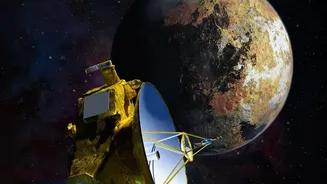
Ever since NASA's New Horizons spacecraft flew past Pluto in 2015, the dwarf planet has been rewriting the textbook on what's possible in the freezing outer reaches of the solar system. Initially expected to be a largely inactive ball of ice and rock,
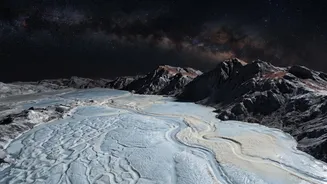
Pluto has revealed a stunningly complex and diverse landscape, with towering mountains of water ice, vast plains, and a dynamic atmosphere. This geological complexity hinted that Pluto might have a source of internal heat, keeping it active billions of years after its formation. One of the most intriguing discoveries was evidence of cryovolcanism—ice volcanoes spewing a slushy mix of water, ammonia, and methane instead of molten rock. These findings opened the door to an even more radical idea: could there be liquid processes at work today?
The Telltale Heart
The focus of the latest research is Pluto's most famous feature: a massive, heart-shaped glacier of frozen nitrogen called Sputnik Planitia. It’s a colossal basin, larger than Texas and Oklahoma combined. New analysis of the New Horizons imagery, published in the Planetary Science Journal, zeroes in on dark streaks and features found along the northern edges of this glacier. Scientists noticed these patterns looked remarkably similar to features on Earth’s own glaciers, specifically in places like Greenland where liquid water emerges from beneath the ice and darkens the surface. Since Pluto's frigid atmosphere makes liquid nitrogen rain impossible, the researchers concluded that the liquid must be coming from below.
Liquid Nitrogen on the Move
The leading theory is that liquid nitrogen is welling up from beneath Sputnik Planitia's kilometers-deep ice sheet. According to computer models, the immense pressure at the base of this massive glacier could be enough to melt the solid nitrogen, creating a subsurface liquid layer. This liquid nitrogen could then be forced upward through cracks and fissures in the ice, temporarily wetting the surface before it freezes or sublimates back into gas. Alan Stern, the principal investigator for the New Horizons mission, stated that this is the first evidence of recently flowing liquid on Pluto. This finding suggests a new kind of time-variable feature, meaning Pluto's surface might be changing, however slowly, right now.
What 'Recent' Really Means
When scientists say 'recent,' it's important to think on a geological timescale. This activity isn't happening in real-time like a river on Earth. The surface of Sputnik Planitia is estimated to be quite young, perhaps less than a million years old, because of the constant churning and renewal of the ice. Therefore, the features created by the liquid nitrogen must have formed within that timeframe. While a million years sounds like a long time to us, it's a mere blink of an eye in the 4.5-billion-year history of the solar system. It suggests that the processes powering this activity could still be ongoing today, deep beneath the ice.
A New Understanding of Icy Worlds
The potential for liquid nitrogen flows on Pluto forces a major rethinking of how such cold, distant bodies operate. It suggests that even without significant solar energy, the combination of internal heat—perhaps from the decay of radioactive elements—and immense pressure can create dynamic geological systems. This process might not be unique to Pluto. Scientists believe similar mechanisms could be responsible for the mysterious geysers observed on Neptune's moon Triton and could be active on other large objects in the Kuiper Belt, the solar system's distant 'third zone'. This discovery transforms Pluto from a static, frozen relic into a world with active 'plumbing' and a complex, evolving surface.