
Why Not Just Use Landing Legs?
SpaceX revolutionized rocketry by successfully landing its Falcon 9 boosters on legs. So why change a winning formula? The answer comes down to mass and speed. The Super Heavy booster, the first stage of the Starship system, is enormous. Equipping it with
landing legs strong enough to support its weight would add a significant amount of mass. Every kilogram launched into the sky costs fuel, so removing the legs means more capacity for payload or more margin for the mission. But the main driver is rapid reusability. SpaceX’s goal is not just to reuse rockets, but to do so at a speed resembling airline operations, with multiple launches per day. Catching the booster directly at the launch site eliminates the time-consuming process of transporting it from a landing zone, inspecting it, and then moving it back to the pad. With Mechazilla, the booster is caught and immediately ready to be stacked for the next flight.
Meet Mechazilla: The Robotic Tower
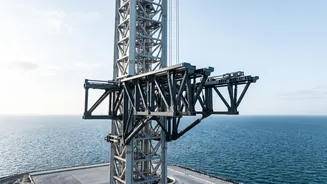
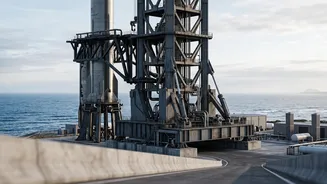
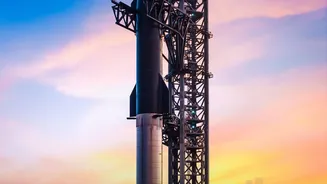
The system, nicknamed 'Mechazilla' by Elon Musk, is more than just a pair of arms; it is an integrated part of the launch infrastructure. The Orbital Launch Integration Tower stands around 146 meters (about 480 feet) tall. Attached to this steel behemoth is a large carriage that can travel up and down the tower. On this carriage are the two famous 'chopstick' arms. These powerful, hydraulically actuated arms are what perform the actual catch. The entire structure is a multi-purpose machine: it supports the rocket for launch, provides the necessary fuel and data connections via an umbilical arm, and then transforms into a recovery device upon the booster's return. This philosophy of moving complexity from the flying rocket to the stationary ground is key; weight is a harsh penalty in rocketry, but a ground tower can be as massive and powerful as needed.
The Ultimate High-Stakes Catch
The sequence of a tower catch is a high-precision ballet of steel and fire. After separating from the Starship upper stage, the Super Heavy booster performs a flip maneuver and fires its engines for a 'boostback burn' to head back toward the launch site. As it descends, it uses its four large grid fins for aerodynamic control, steering itself toward the tower. In the final moments of its descent, the booster executes a final landing burn, using its Raptor engines to slow itself to a near-hover just above the catch arms. This is where the tower's 'chopsticks' come into play. As the booster descends slowly between them, the arms close and clamp onto structural hardpoints located near the top of the booster, just below the grid fins. These points are already reinforced to handle the immense aerodynamic forces during descent, making them ideal for the catch. With the booster secured, the arms can then place it back on the launch mount, ready for its next mission.
The Billion-Dollar Gamble
The risks are as colossal as the rocket itself. A miscalculation, a gust of wind, or a faulty engine burn could lead to the booster missing the arms and crashing into the launch tower, a catastrophic failure that would destroy both the multi-million dollar rocket and its essential launch infrastructure. The precision required is extraordinary, demanding flawless coordination between the booster's guidance systems and the ground robotics. However, the reward is what makes this gamble central to SpaceX's entire business case for Starship. Achieving rapid, full reusability could slash the cost of accessing orbit by 99% or more. This doesn't just make launching satellites cheaper; it is the fundamental enabler for SpaceX's most ambitious goals, such as deploying the next generation of its Starlink network and, eventually, building a self-sustaining city on Mars.
Is It Actually Working?
This is not just a concept on a drawing board. SpaceX has been actively testing and iterating the system at its Starbase facility in Texas. The first successful catch of a Super Heavy booster occurred on October 13, 2024, with Booster 12, a milestone that proved the seemingly impossible was, in fact, achievable. Since that historic catch, SpaceX has continued its rapid development, pushing the system's limits with subsequent flight tests. While not every landing attempt has targeted a catch, the company is also working towards catching the Starship upper stage itself, a maneuver that has not yet been accomplished but is planned for an upcoming flight. Each flight, whether it ends in a perfect catch or a splashdown in the Gulf of Mexico, provides crucial data that refines the hardware and software, bringing SpaceX closer to its goal of routine, airline-like space operations.