




The 'City of Palaces'
Kolkata’s famous nickname, the 'City of Palaces', isn't just a flight of fancy. It dates back to the 18th and 19th centuries when, as the capital of British India, the city was transformed into a showcase of imperial power. The British East India Company
and wealthy Bengali families constructed grand buildings that blended Neoclassical, Gothic, and Victorian styles. This architectural boom created a cityscape so grand that early European travellers were stunned by its scale. The administrative heart of this era was Dalhousie Square, now called B.B.D. Bagh. This area, packed with stately administrative buildings like the Writers' Building and the General Post Office, was the epicentre of British commercial and political life, earning it the title of the 'second city' of the British Empire after London.
Walk Through 'White Town'
To truly understand Kolkata's colonial past, you have to walk through it. A heritage walk around B.B.D. Bagh is like stepping onto a film set of the British Raj. The area, once known as 'White Town', is a dense concentration of colonial-era structures. Start at the iconic Writers' Building, the former secretariat for the East India Company's clerks, or 'writers'. Nearby, you'll find the impressive General Post Office with its towering dome, built over the site of the original Fort William. Don't miss St. John's Church, one of the first public buildings erected by the East India Company in the city. Each corner turned reveals another layer of history, from the Calcutta High Court's neo-Gothic design to the classical columns of surrounding commercial buildings.
The Crown Jewel: Victoria Memorial
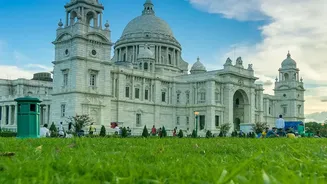
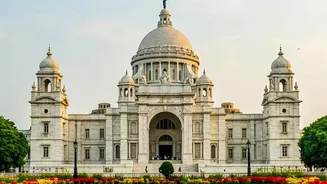
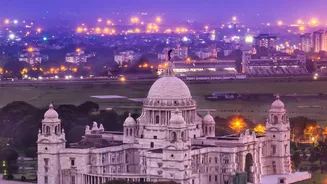
No landmark embodies the 'London of India' label more than the Victoria Memorial. Conceived by Viceroy Lord Curzon after Queen Victoria's death, this magnificent monument of white Makrana marble was intended to be a tribute to the peak of the British Empire. Built between 1906 and 1921, its design fuses European styles with Mughal influences, creating a structure that is both grand and elegant. The central dome is often compared to St. Paul's Cathedral in London, while the use of marble echoes the Taj Mahal. Today, it functions as a museum housing a vast collection of paintings, artefacts, and manuscripts from the colonial period. Surrounded by 64 acres of lush gardens, it stands as Kolkata's most iconic and breathtaking architectural treasure.
A Ride on the Historic Trams
While many cities have dismantled their old transport systems, Kolkata has held onto its historic tram network, the only one still operating in India. A ride on one of these charmingly slow-moving vehicles is less about getting somewhere quickly and more about experiencing the city's living heritage. The trams offer a unique vantage point for appreciating the blend of colonial and modern architecture, allowing you to soak in the street life at a leisurely pace. For a scenic journey, hop on a route that passes through the Maidan, the city's vast urban park, giving you views of the green expanse against the backdrop of historic buildings. It's a nostalgic experience that connects you directly to the city's European-influenced past.
The Enduring Charm of Park Street
Once the epicentre of Kolkata's nightlife in the mid-20th century, Park Street (now Mother Teresa Sarani) still pulses with a vibrant, cosmopolitan energy. Historically, this was the go-to destination for live jazz, cabaret, and fine dining, with legendary establishments like Mocambo and Blue Fox setting the scene. While the street has evolved, it retains its sophisticated charm. You can still dine at these iconic restaurants or enjoy a pastry at Flurys, a tearoom that dates back to 1927. The area also has a deeper history, once being known as Burial Ground Road. A visit to the serene South Park Street Cemetery offers a fascinating, quiet contrast to the lively street, with ornate 18th-century tombs of early European residents standing under a canopy of trees.
Where British Heritage Meets Bengali Soul
Kolkata's identity is not solely defined by its colonial architecture. The city's true magic lies in the fusion of its British past with its powerful Bengali culture. This is the city of the Bengal Renaissance, a cradle of intellectual and artistic awakening. To experience this, venture to College Street, home to the country's largest second-hand book market and the historic Indian Coffee House, a legendary hub for generations of students, poets, and thinkers. Here, the spirit of 'adda'—passionate, free-wheeling conversation—is alive and well. Exploring these cultural landmarks reveals that while the British built the city's grand facade, its enduring heart and soul are unmistakably Bengali.