
A Lunar Treasure Map
For decades, scientists have theorized that the Moon’s poles held frozen water, but confirming its location and, crucially, its accessibility, has been a major challenge. This new research provides some of the most compelling evidence to date. Using data
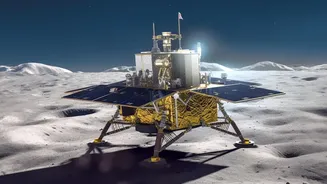
from a sophisticated instrument called a neutron spectrometer, scientists have mapped out hydrogen-rich zones near the lunar south pole. In the simple chemistry of space, finding high concentrations of hydrogen is a very strong indicator of water (H2O). What makes this discovery particularly exciting is that the maps indicate this ice is located within the top few feet of the lunar soil, or regolith. This isn't a deep, unreachable resource; it's close enough to the surface that future missions could potentially excavate it with robotic equipment.
How to Find Water from Space
Detecting water from orbit sounds like science fiction, but the method is surprisingly clever. The Moon is constantly bombarded by cosmic rays from deep space. When these high-energy particles strike the lunar surface, they create a spray of other particles, including neutrons. A neutron spectrometer doesn't see water directly; instead, it counts these escaping neutrons. When neutrons collide with hydrogen atoms—the 'H' in H2O—they lose a significant amount of energy, and fewer of them bounce back up to the spectrometer in orbit. By scanning for areas with a low count of these specific neutrons, scientists can create a map that essentially points to 'X marks the spot' for hydrogen, and therefore, for water ice. This technique has been refined over several missions, but these new maps provide an unprecedented level of detail about the south pole region.
The Moon's New Gold Rush
Finding water on the Moon is about much more than giving future astronauts something to drink. Water is often called the 'oil of the solar system' because it is a critical, multi-purpose resource. It can be purified for drinking and used to grow plants in a lunar habitat. More importantly, it can be split into its component elements, hydrogen and oxygen, through a process called electrolysis. Oxygen is essential for breathable air. Both hydrogen and oxygen are the primary components of powerful rocket fuel. Being able to manufacture air, water, and fuel directly on the Moon would drastically reduce the cost and complexity of human missions. Instead of launching everything from Earth—a hugely expensive undertaking—lunar bases could become self-sustaining depots, and even service stations for missions to Mars and beyond.
India's Stake in the Lunar South Pole
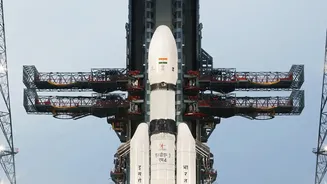
This discovery holds special significance for India. The Indian Space Research Organisation (ISRO) made history with its Chandrayaan program, becoming the first to land a spacecraft, Chandrayaan-3, in the Moon's south polar region in 2023. This strategic choice was driven by the strong scientific evidence that the region harboured water ice. India's Chandrayaan-1 orbiter, launched back in 2008, carried a NASA instrument that provided some of the first definitive proof of water on the Moon. The success of Chandrayaan-3 solidified India's position as a major player in lunar exploration. ISRO is already partnering with Japan's JAXA on a future rover mission, LUPEX, which will also carry a neutron spectrometer to further explore the south pole for water resources. This new global data confirming accessible ice validates India’s scientific focus and bolsters the case for its future lunar ambitions.