






A Mission to a Metal World
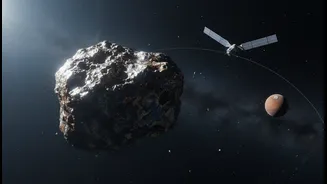
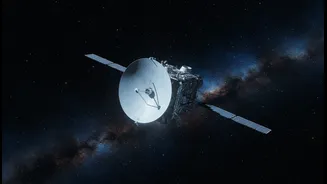
Before we get to the Martian maneuver, let's talk about the destination. Launched in October 2023, the Psyche mission is on a long journey to the main asteroid belt located between Mars and Jupiter. Its target is a unique, metal-rich asteroid, also named
Psyche. This object, about 280 kilometers across at its widest point, is thought to be the exposed core of a planetesimal, an early planetary building block. Scientists believe that visiting Psyche could offer a one-of-a-kind window into how planets like Earth formed, allowing us to study a planetary core up close—something that's impossible to do on our own world. Is it a solid chunk of iron and nickel, or something else entirely? The spacecraft's suite of scientific instruments is designed to find out when it arrives in 2029.
The Martian Slingshot
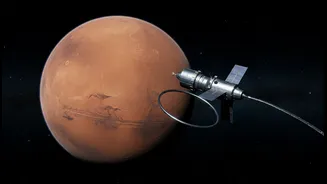
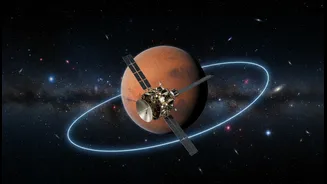
To get to its distant target, Psyche needed a boost. In May 2026, the spacecraft performed a carefully choreographed flyby of Mars, passing just over 4,600 kilometers above the planet's surface. This wasn't a sightseeing detour; it was a critical, pre-planned maneuver known as a gravity assist. As Psyche entered Mars's gravitational field, it was pulled in and accelerated. Then, as it flew away, its trajectory was bent. The entire encounter acted like a massive slingshot. Mission navigators at NASA's Jet Propulsion Laboratory confirmed that the flyby boosted Psyche's speed by about 1,600 kilometers per hour and, just as importantly, tilted its orbital plane by about one degree. That slight change in direction is crucial for aligning the spacecraft's path with the asteroid's orbit.
How a Gravity Assist Works
A gravity assist can feel like getting something for nothing, but it's all about a clever transfer of momentum. Think of a tennis ball bouncing off the front of a moving train. The ball not only changes direction but also flies away much faster because it has absorbed a tiny bit of the train's immense forward momentum. In space, the spacecraft is the tennis ball and the planet is the train. As the spacecraft approaches a planet, the planet's gravity pulls it in, causing it to speed up. It then swings around the planet and heads off in a new direction. Because the planet is also moving in its own orbit around the Sun, the spacecraft can 'steal' a tiny amount of this orbital energy. The planet slows down in its orbit by an immeasurably small amount, while the much lighter spacecraft gets a significant speed boost. This technique has been a cornerstone of interplanetary travel for decades, used by missions like the Voyager probes to explore the outer solar system.
Why Saving Fuel Is Everything
The main benefit of a gravity assist is the massive saving in propellant. Every kilogram of fuel has to be launched from Earth, which is incredibly expensive. By using Mars's gravity, the Psyche mission saved propellant that would have been needed to achieve the same speed and trajectory change. This is especially important for a mission like Psyche, which uses a highly efficient but low-thrust solar electric propulsion system. Its Hall-effect thrusters gently push the spacecraft by expelling ionized xenon gas, providing a thrust equivalent to the pressure of holding a few coins in your hand. While this system is perfect for a long cruise through deep space, it's not designed for powerful, rapid burns. The gravity assist provided a major course correction and speed increase that would have taken the thrusters a very long time to accomplish, saving both time and fuel. That conserved fuel can now be used for maneuvering the spacecraft once it arrives at the asteroid Psyche, potentially extending the mission's scientific operations.