


How to See Weather Light-Years Away
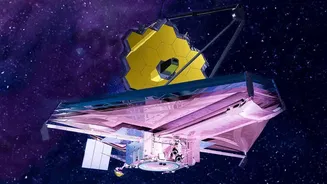
It seems impossible to know the weather on a planet hundreds of light-years away, a world we can't even see directly. The secret lies in a technique called spectroscopy. When an exoplanet passes in front of its star from our perspective—an event called a transit—a
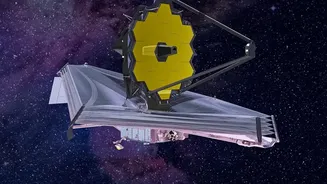
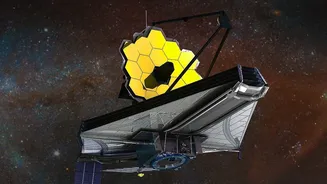
tiny fraction of the starlight filters through the planet’s atmosphere. Powerful infrared telescopes, like the James Webb Space Telescope (JWST) and the European Southern Observatory's Very Large Telescope (VLT), can capture this light. Every chemical element and compound absorbs light at a unique wavelength, creating a chemical fingerprint. By analyzing which colours are missing from the starlight after it passes through the atmosphere, astronomers can determine exactly what gases are present, including vaporized metals.
A Forecast of Iron Rain
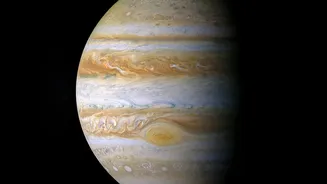
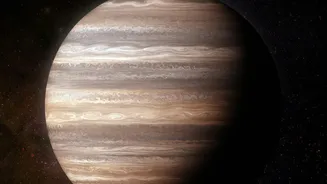
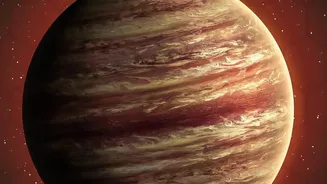
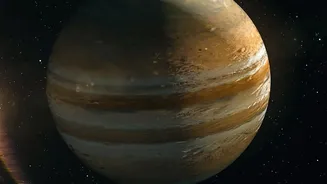
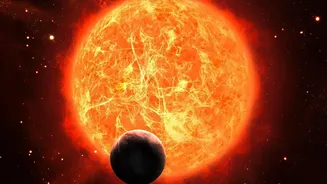
One of the most extreme examples is the exoplanet WASP-76b, located about 640 light-years from Earth. This 'hot Jupiter' is tidally locked, meaning one side perpetually faces its star while the other is in permanent darkness. The day side gets so hot—over 2,400 degrees Celsius—that metals like iron vaporize into the atmosphere. Powerful winds then carry this iron vapour over to the cooler night side. As the temperature drops to a still-scorching 1,500 degrees Celsius, the iron gas condenses into liquid droplets and falls as molten iron rain. Astronomers confirmed this by detecting a strong iron signature on the evening edge of the planet, but not on the morning edge, indicating the iron had rained out during the night.
Winds Faster Than Sound
As if iron rain wasn't extreme enough, astronomers have also measured mind-bogglingly fast winds. On another gas giant, WASP-127b, scientists have clocked a jet stream at its equator moving at up to 33,000 kilometres per hour. That's more than 18 times faster than the fastest winds ever recorded in our own solar system, which were found on Neptune. These supersonic winds are driven by the huge temperature difference between the planet's blistering day side and its cooler night side. This thermal gap acts like a massive engine, creating atmospheric currents that make Earth's most powerful hurricanes seem like a gentle breeze. On some planets, these wind speeds are actually slower than models predict, leading scientists to believe that magnetic fields may be creating a form of atmospheric drag, a brand new area of exoplanetary weather research.
A Universe of Diverse Climates
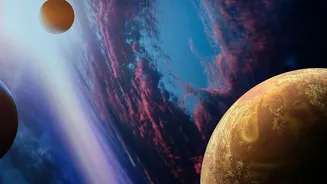
These discoveries are more than just cosmic curiosities. They reveal the incredible diversity of planets in our galaxy. While hot Jupiters with iron rain are inhospitable, studying their extreme atmospheres helps scientists test and refine their models of planetary climate. The same techniques used to find vaporized iron on WASP-76b are being used by the JWST to find water, methane, and carbon dioxide on other worlds. Some planets have clouds made of silicates—essentially sand—while others might have clouds of salt or even the building blocks of rubies and sapphires. By understanding the full spectrum of what's possible, from scorching gas giants to cooler, rocky worlds, we gain a deeper appreciation for the complex forces that shape planets, including our own.