





Recovery at Sea
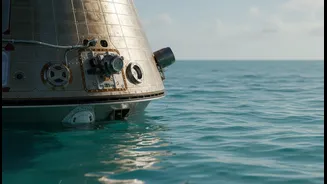
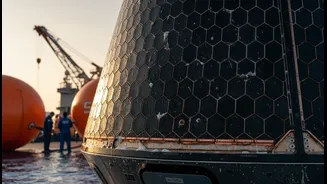
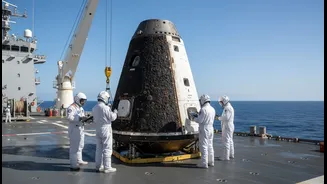
The first step in Orion's post-flight process begins moments after its parachute-assisted splashdown in the Pacific Ocean. A highly trained Landing and Recovery Team, a joint effort led by NASA's Exploration Ground Systems with support from the U.S. Navy,
is responsible for safely recovering the capsule. Divers approach the spacecraft to secure it before it is carefully guided into the well deck of a waiting naval ship, like the USS Portland used for Artemis I or the USS John P. Murtha for Artemis II. This phase is about more than just retrieval; it’s the first opportunity for engineers to visually inspect the vehicle and begin the process of powering it down safely after its long journey.
The Journey Home
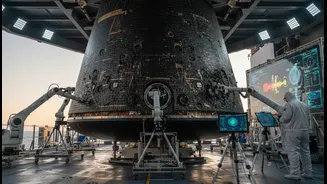
Once secured aboard the ship, Orion begins a multi-day journey back to land, eventually heading cross-country to NASA's Kennedy Space Center in Florida. This isn't a simple road trip. The spacecraft is loaded onto a specialized trailer for a carefully mapped route that requires state permits and specific travel windows to minimize public disruption. Upon arrival, the real work begins as teams at Kennedy start the methodical process of 'de-servicing' the capsule. This involves safely removing any hazardous materials and preparing the vehicle for a deep-dive inspection.
Unlocking the Data Trove
Orion is more than just a vehicle; it's a flying data recorder. Before most physical inspections begin, engineers download a treasure trove of information from the spacecraft's computers. This telemetry includes everything from the performance of flight systems and navigation to the effectiveness of the life support systems that kept the crew safe. For Artemis II, this data is particularly vital as it contains the first direct measurements of how the human body responds to the deep space radiation environment in over 50 years. This biological data, collected from the crew via samples and sensors, is crucial for planning longer-duration missions to the Moon and eventually Mars.
The All-Important Heat Shield
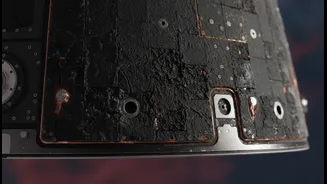
Perhaps the most intensely scrutinized component is the heat shield. After the uncrewed Artemis I mission showed unexpected erosion and char loss, engineers were laser-focused on its performance during Artemis II. The shield, which protects the capsule from temperatures reaching nearly 2,760 degrees Celsius during reentry, is meticulously examined. Samples are taken from its ablative material, known as Avcoat, and sent for analysis. Following Artemis I, engineers determined that trapped gases caused some of the char layer to break away. The successful performance of the Artemis II shield, which experienced far less char loss, validated the corrective measures and complex modeling done to ensure crew safety.
Inspecting Every Bolt and Seam
Beyond the heat shield, every part of the Orion capsule is subject to inspection. Engineers examine the parachutes, forward bay cover, and separation bolts, components whose performance is critical for a safe landing. They also begin the process of identifying parts that can be reused on future missions. The Artemis program is built on the idea of reusability to make deep space exploration more sustainable. While Artemis I reused a handful of components for Artemis II, the plan is to scale this up significantly, with thousands of components from the Artemis II vehicle potentially being certified to fly again on later missions, paving the way for a more modular and efficient approach to building spacecraft.