


A Glimpse of the Cosmic Dawn
The James Webb Space Telescope (JWST) is not just a telescope; it's a time machine. By capturing faint infrared light that has travelled for over 13 billion years, it allows astronomers to see the universe as it was in its infancy. Recent images are pushing
the boundaries of what we thought was possible, peering into an era just a few hundred million years after the Big Bang. This period, known as the cosmic dawn, is when the very first stars and galaxies were thought to be slowly and messily coming into existence. What JWST is finding, however, is anything but slow and messy. It’s revealing a cosmic nursery filled with surprisingly grown-up inhabitants.
Galaxies Too Big, Too Soon
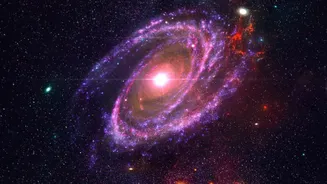
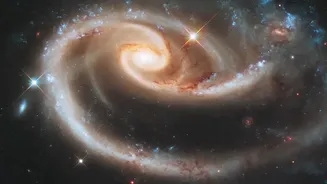
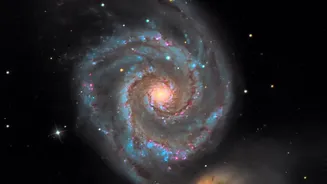
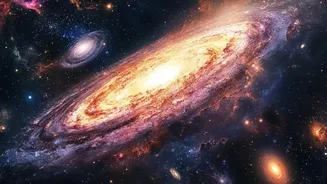
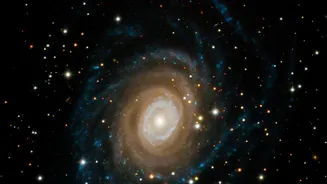
The most startling revelation is the discovery of galaxies that appear far too massive and mature for their age. According to long-standing cosmological models, the first galaxies should have been small, chaotic, and disorganized collections of stars. Yet, JWST has identified multiple galaxy candidates from this early period that are staggeringly massive, with one even appearing to rival the size of our own Milky Way, which had billions more years to grow. Furthermore, some of these ancient galaxies show signs of complex structures, such as rotating disks and even early spiral arms—features scientists believed took an immense amount of time to develop. This has become one of the most pressing questions in modern astronomy.
Rewriting the Rules of Galaxy Formation
These discoveries pose a direct challenge to the standard model of cosmic evolution, often called the hierarchical model. This theory posits that large galaxies are built up gradually over billions of years through the slow merger of smaller ones. But the presence of these unexpectedly large and structured early galaxies suggests that the process might have been much faster for some. Scientists are now grappling with what this means. Did the universe expand faster right after the Big Bang than we predict? Did the first galaxies convert nearly all of their available gas into stars with astonishing efficiency, a rate far exceeding the 10% conversion typically seen today? These questions are forcing a fundamental rethink of the universe's early chapters.
The Mystery of the 'Little Red Dots'
Adding another layer to the puzzle are mysterious objects that astronomers have nicknamed 'Little Red Dots'. First discovered in 2024, hundreds of these faint, red objects have been detected by JWST in the very early universe. Scientists are working to determine what they are. One leading theory is that they are the bright nuclei of primordial galaxies, powered by supermassive black holes. If true, this raises its own difficult questions about how such massive black holes could have formed so quickly after the Big Bang, a process thought to require a significant amount of time. These enigmatic dots could hold the key to understanding the rapid growth of structures in the dawn of the cosmos.
Why This Cosmic Story Matters
While these galaxies are unfathomably far away, understanding their origin story is crucial to understanding our own. Every discovery about how the first stars ignited and how galaxies organized themselves provides a piece of our cosmic family history. The infrared eyes of the JWST are piercing through cosmic dust and time, allowing us to see the construction site of the universe. By studying these protoclusters and early galaxies, astronomers are essentially watching the universe build its largest structures in a hurry. These findings don’t just refine old theories; they open up entirely new avenues of inquiry about the forces that shaped everything we see today, including our own galaxy and solar system.