


The Pristine Delivery
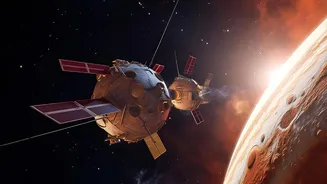
The journey from deep space to the laboratory is fraught with one major peril: earthly contamination. Missions like NASA's OSIRIS-REx and JAXA's Hayabusa2 go to extraordinary lengths to protect their cargo. Once a sample return capsule lands, it is whisked
away to a specialised curation facility. These labs are ultra-clean environments, far more sterile than a standard hospital operating theatre. Scientists handle the samples inside gloveboxes filled with inert nitrogen gas, preventing any contact with Earth's oxygen, water, or stray microbes that could corrupt the priceless material before analysis can even begin. The entire process is designed to break the chain of contact between the extraterrestrial sample and our own biosphere.
Extraction: A Delicate Wash
To find organic molecules like amino acids, scientists must first coax them out of the rock and dust. This is a delicate process, as the molecules of interest are present in minuscule amounts, often parts per billion. A common method involves taking a tiny portion of the sample, sometimes just a few milligrams, and carefully washing it. Typically, this involves submerging the sample in ultrapure water and heating it to release any soluble organic compounds into the liquid. This 'water extract' now holds a complex soup of molecules, a mixture of cosmic ingredients that need to be carefully separated and identified. This step is crucial, as different extraction methods can affect which types of molecules are recovered.
Separating the Ingredients
With a liquid extract in hand, the next challenge is to separate the jumble of different molecules. This is the job of chromatography. The technique works like a filter, sorting molecules based on their physical and chemical properties. In liquid chromatography (LC), the sample extract is passed through a column packed with a special material. Different molecules travel through the column at different speeds, causing them to emerge at separate times. A similar technique, gas chromatography (GC), is used for molecules that can be vaporised. It separates compounds based on their boiling points as they travel through a very long, thin tube. The result is a stream of individual, sorted molecules, ready for positive identification.
The Final Identification
Once separated, each molecule is sent into a mass spectrometer. This device acts like a hyper-sensitive scale for molecules, measuring their exact mass with incredible precision. By bombarding the molecules with electrons, the spectrometer gives them an electrical charge and then measures how they behave in a magnetic field. Heavier molecules are deflected less, while lighter ones are deflected more. This allows scientists to determine the precise mass of each compound that came out of the chromatograph. By comparing these mass signatures to a library of known molecules, researchers can confirm the presence of specific amino acids—such as glycine and alanine, which were found in samples from the asteroid Bennu—or other organic compounds.
Confirming an Alien Origin
Just finding an amino acid isn't enough; scientists must prove it didn't hitch a ride from Earth. One key method is analysing 'chirality'. Many amino acids exist in two forms that are mirror images of each other, known as 'left-handed' (L) and 'right-handed' (D). Life on Earth exclusively uses left-handed amino acids. Finding a near-equal mix of both left- and right-handed forms, as was seen in the Bennu samples, is a strong indicator that the molecules formed through non-biological processes in space. Another technique is looking at isotopes—atoms of the same element with different masses. Extraterrestrial materials often have unique isotopic signatures that distinguish them from anything found on our own planet, providing the final proof of their cosmic origin.