
An Ancient Storm Unlike Any Other
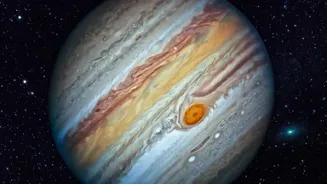
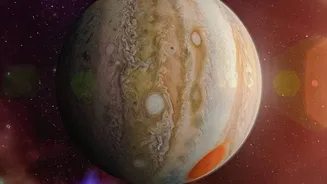
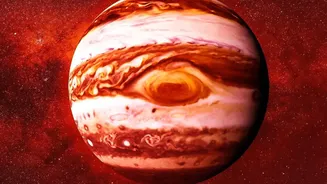
For at least 150 years, and possibly much longer, astronomers have gazed at the magnificent, crimson vortex in Jupiter’s southern hemisphere. The Great Red Spot is the largest and most powerful storm in our solar system, an anticyclone so vast that at one time
it could have swallowed three Earths. Its winds whip around at speeds exceeding 500 kilometres per hour, creating a spectacle of deep reds and oranges embedded in the planet's pale yellow and white cloud bands. Unlike hurricanes on Earth that form over water and die out over land, Jupiter’s giant storm has no land to slow it down, allowing it to rage for centuries as a seemingly permanent fixture of the gas giant's turbulent atmosphere.
A Sharper View Reveals Constant Change
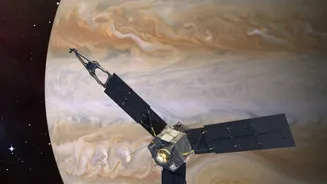
The headline's "new camera captures" refer to ongoing observations from advanced instruments like the Hubble Space Telescope and the James Webb Space Telescope (JWST). These powerful observatories provide unprecedented detail, revealing that the Great Red Spot is far from static. Recent data, collected over just 90 days, showed the storm wobbling, fluctuating in size, and changing shape in ways never seen before. Scientists were surprised to see the spot squeezing in and out while its rotational speed changed. The so-called "cosmic tornados" are not literal tornados, but smaller eddies and vortices at the storm's edge. High-resolution images show these smaller storms feeding into the main vortex, a process that scientists believe alters its internal dynamics.
The Incredible Shrinking Spot
One of the most dramatic findings is that the Great Red Spot is shrinking. This isn't entirely new—astronomers have tracked its downsizing since the 1930s. In the late 1800s, the storm was estimated to be over 40,000 kilometres across. By the time the Voyager probes flew by in 1979, it had shrunk to about 23,000 kilometres. More recent Hubble observations confirm it is now less than 16,500 kilometres across, the smallest ever measured. For a period starting around 2012, the rate of shrinkage accelerated to nearly 1,000 kilometres per year, causing the storm's shape to become more circular than oval. While that rate appears to have slowed recently, the long-term trend of contraction continues.
What Is Causing the Changes?
The exact cause of the shrinking and shifting is still a mystery, but scientists have compelling theories. One leading hypothesis is that the changes are linked to the behaviour of the smaller vortices, or eddies, that interact with the main storm. These smaller storms can either feed momentum into the Great Red Spot, sustaining it, or sap its energy, causing it to shrink. Recent studies suggest that a decrease in the number or frequency of these smaller storms feeding into the main one might be responsible for its accelerated shrinking. It's a complex dance of atmospheric dynamics, where the colossal storm's longevity depends on its interactions with the weather systems around it.
Why This Distant Storm Matters
Studying the Great Red Spot isn't just about a faraway planet. The dynamics that govern Jupiter's atmosphere are based on the same principles of fluid dynamics that control weather on Earth. By observing this massive, long-lived storm, scientists can test and refine their models of how weather systems work on a planetary scale. It provides a natural laboratory for understanding atmospheric forces that is impossible to replicate on Earth. These insights can improve our understanding of everything from our own planet's climate to the weather on exoplanets orbiting distant stars, putting Earth's hurricanes into a broader cosmic context.