



What Exactly is a Quasar?
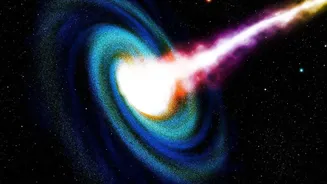
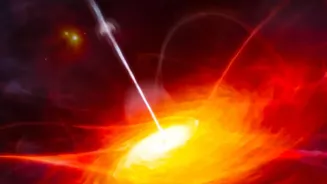
Before we dive into the discovery, let's clarify what a quasar is. The name is short for 'quasi-stellar radio source'. They are not stars, but they are so bright they can look like them. A quasar is the extremely luminous core of a distant galaxy. This
intense light is generated by a supermassive black hole at the galaxy's center, which is actively 'feeding' on surrounding gas and dust. As this material gets pulled in, immense gravitational and frictional forces heat it to incredible temperatures, causing it to shine with an intensity that can outshine all the stars in its host galaxy combined. This makes them visible across billions of light-years, allowing us to see them as they were in the very distant past.
A Glimpse of the Cosmic Dawn
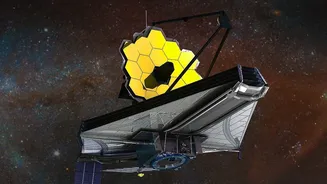
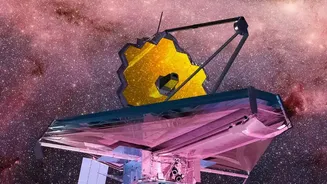
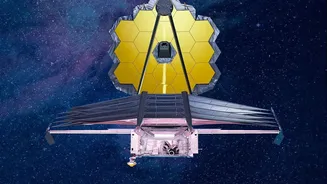
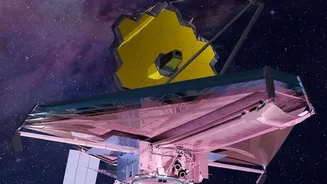
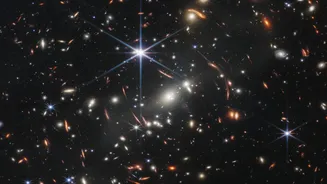
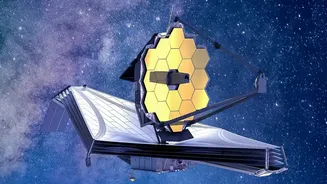
The JWST, a technological marvel, and the ground-based Gemini North telescope in Hawaiʻi were used to spot this ancient duo. The pair, officially known as J1602+4228AB, is seen as it was just 900 million years after the Big Bang. This period is known as the 'cosmic dawn', a time when the very first stars, galaxies, and black holes were forming. Finding even one such object so early is a puzzle for astronomers, but the JWST's incredible sensitivity to infrared light allows it to peer back to this era, effectively acting as a time machine to study the universe's formative years.
An Impossible Pair
The discovery is stunning for several reasons. First, the black holes powering these quasars are enormous. One has a mass about 1.5 billion times that of our Sun, while its companion is around 400 million solar masses. According to current models, there simply shouldn't have been enough time for black holes to grow this massive so early in the universe's history. As one researcher noted, there's no definitive theory for how even a single one of these giants could exist so early, let alone two of them together. Finding a pair makes the discovery even more significant and challenging to explain.
A Cosmic Conundrum
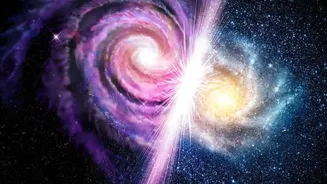
The proximity of the two quasars adds another layer to the mystery. They are separated by only 18,100 light-years, which is roughly one-fifth the diameter of our own Milky Way galaxy. This makes it the most distant and compact quasar pair ever found from this era. Theories have long predicted that pairs of quasars should exist as a result of galaxy mergers, which were common in the early universe. However, observing them is incredibly difficult because the quasar phase is cosmically brief and their great distance makes them hard to resolve as two separate objects. This discovery provides a rare, direct look at this crucial process in action.
Rewriting Our Origin Story
This record-breaking pair, nicknamed Nāpōwawāʻenakaulua, acts as a unique laboratory for understanding how the first massive galaxies and their black holes grew. Scientists believe the system is located in an area of the early universe that was exceptionally dense with matter. Such an environment would have fueled rapid galaxy collisions and intense star formation, which in turn would accelerate the growth of the black holes at their centers. The finding challenges existing models and will force cosmologists to rethink how quickly large-scale structures could form after the Big Bang, offering a vital clue in the ongoing quest to understand our cosmic origins.