








A Moon Like No Other
Saturn's largest moon, Titan, is one of the most intriguing destinations in our solar system. It is the only moon with a dense atmosphere, even thicker than Earth's, and it hosts an Earth-like cycle of clouds, rain, and liquid-filled lakes and rivers.
But on Titan, the liquid isn't water; it's methane and ethane. Beneath its hazy orange sky lies a world rich in complex organic molecules, the carbon-based compounds that are fundamental to life as we know it. Scientists believe Titan's environment is similar to that of the very early Earth, making it a natural laboratory for studying how life might arise. The Cassini-Huygens mission, which landed a probe on Titan in 2005, gave us a tantalizing glimpse, but to truly understand this world, we need to explore multiple locations on the ground.
Why a Flying Machine?
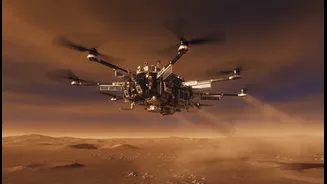
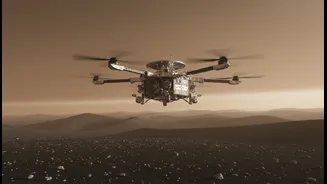
Exploring a world as diverse as Titan requires mobility. Mars rovers have proven invaluable, but their progress is slow. Titan presents a unique opportunity for a different kind of exploration. Its atmosphere is four times denser than Earth's, and its gravity is only about one-seventh as strong. These conditions make it a perfect place to fly. Enter Dragonfly, an eight-rotor vehicle, often called an octocopter, that operates like a giant drone. This design allows it to travel much farther and faster than a ground-based rover ever could. During its mission, planned to last nearly three years, Dragonfly is expected to fly over 175 kilometers, performing a series of 'leapfrog' flights of up to 8 kilometers at a time to move from one scientifically interesting site to another. This allows the mission to sample a wide variety of geologic environments, from organic sand dunes to the floor of an ancient impact crater where liquid water may have once mixed with organic materials.
A Laboratory on Wings
Dragonfly is much more than just a drone; it's a fully equipped, mobile science laboratory. Its primary goal is to investigate Titan's prebiotic chemistry and habitability. To do this, it carries a suite of sophisticated instruments. The Dragonfly Mass Spectrometer (DraMS) will analyze the chemical composition of surface materials to search for biologically relevant compounds. To collect samples, the DrACO drill will bore into the surface and pneumatically transfer the material to the mass spectrometer. Meanwhile, the DraGNS gamma-ray and neutron spectrometer will measure the composition of the ground beneath the lander, and the DragonCam camera suite will provide panoramic images of the alien landscape. The craft will also carry meteorological sensors to study Titan's weather and a seismometer to detect 'Titanquakes'. This powerful combination of instruments will provide an unprecedented look at the complex chemistry occurring on Titan's surface.
Engineering for an Alien World
Building a machine to fly on Titan is an immense engineering challenge. The rotorcraft must survive a launch from Earth, a long journey through space, and a fiery entry through Titan's atmosphere before it even begins its aerial exploration. The environment on Titan is extreme, with surface temperatures around a frigid -179 degrees Celsius. To keep its vital electronics and batteries warm, Dragonfly will be powered by a Multi-Mission Radioisotope Thermoelectric Generator (MMRTG), the same type of nuclear power source used on Mars rovers like Curiosity and Perseverance. This generator provides constant heat and power, allowing the rotorcraft to recharge during the long Titan nights, which last about eight Earth days. Recent tests have confirmed the structural integrity of the spacecraft, ensuring it can withstand the vibrations of launch and the high pressures of Titan's dense atmosphere, bringing this ambitious mission one step closer to its 2028 launch date.