




A New Cosmic Detective
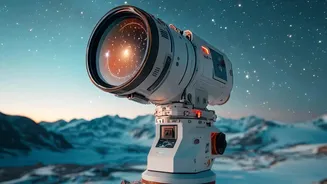
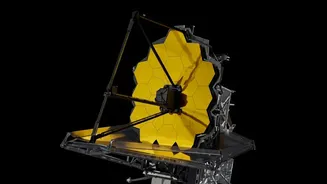
Launched in late August 2026, the Nancy Grace Roman Space Telescope is NASA's next great observatory, set to work alongside missions like the James Webb Space Telescope. But where Webb provides deep, narrow views, Roman is a wide-angle powerhouse. Its
primary mirror is the same size as Hubble's, but its Wide Field Instrument can image an area of the sky over 100 times larger, with the same exquisite detail. This panoramic capability is what makes Roman uniquely suited for mapping the grand structures of the cosmos and, in doing so, tackling the twin enigmas of dark matter and dark energy. Over its mission, it will measure the light from a billion galaxies, offering a vast new dataset for cosmologists.
The Hunt for Dark Energy
Scientists once assumed the universe's expansion, which started with the Big Bang, would gradually slow down due to gravity. Instead, observations show it's accelerating. The mysterious force driving this acceleration has been named dark energy. It seems to be a property of space itself; as space expands, more dark energy comes into being, pushing everything apart even faster. Roman will investigate dark energy using multiple methods. It will hunt for thousands of Type Ia supernovae, a specific kind of stellar explosion that always peaks at a known brightness. By measuring how bright these "standard candles" appear, astronomers can precisely calculate their distance and how fast they are moving away from us, providing a detailed history of cosmic expansion.
Mapping the Invisible Scaffolding
Dark matter is the invisible 'glue' that holds galaxies and galaxy clusters together. We can't see it, but we know it's there because its gravitational pull prevents galaxies from spinning themselves apart. It makes up about 27% of the universe. Roman will create the most comprehensive 3D map of dark matter ever attempted by observing a phenomenon called weak gravitational lensing. Massive objects, including clumps of dark matter, bend the fabric of spacetime, causing the light from more distant galaxies to become subtly distorted. By analyzing the warped shapes of millions of galaxies, Roman will trace the distribution of all matter, both visible and dark, across the cosmos. This map will show how the universe's cosmic web has grown over eons.
Competing Forces and Cosmic Structure
Dark matter and dark energy are competing forces: dark matter pulls things together, while dark energy pushes them apart. Roman's vast surveys will examine how this cosmic tug-of-war has played out over billions of years. By mapping the clustering of galaxies, the telescope will chart imprints left over from sound waves that rippled through the very early universe, known as baryonic acoustic oscillations. The scale of these patterns at different cosmic epochs reveals how quickly the universe was expanding at the time. By combining this data with its weak lensing maps and supernova observations, Roman will provide multiple, independent checks on the properties of dark energy and dark matter. These precise measurements will test Albert Einstein's theory of general relativity on cosmic scales and could help scientists determine if dark energy's influence has changed over time.